
OmniTRAX adds Alabama chemical manufacturer to network
Freedom Intermodal Expands Operations in New Orleans East
Railroad members! If you want to be featured in this section, please email us the link. You can also tag us (@ASLRRA) in your social media posts. Interested in seeing your railroad showcased in your local newspaper? Contact Amy Krouse for assistance.
With rail projects, what can seem like a straightforward plan requires significant coordination and effort to execute. For Watco’s Kanawha River Railroad (KNWA), establishing service for an existing customer’s new coal mine was, at times, literally an uphill battle.
In 2023, Alpha Metallurgical Resources (AlphaMet) was looking to open a new coal mine in Pax, West Virginia. The mine was adjacent to KNWA, but making the connection required short line flexibility and ingenuity.
To capture this new business, KNWA agreed to a flexible growth plan. The KNWA team helped secure favorable freight rates for AlphaMet and worked with Class I partners to ensure they could accommodate increased traffic.
Coal from the new mine would have to be cleaned, or separated from rocks and other impurities, before it could be shipped to market. KNWA already served AlphaMet’s Mammoth cleaning facility in Cannelton, West Virginia, shipping unit trains to interchange with Norfolk Southern for connection to the national rail network. Ensuring the success of the entire project meant connecting the new mine to KNWA’s main line.
AlphaMet designed, funded and built the required rail infrastructure at the new mine site, including siding for at least 50 railcars and a new switch. AlphaMet also built trackage and a new switch at the Mammoth facility to allow simultaneous loading and unloading of outbound and inbound trains. To move the coal, AlphaMet leased 50 new hopper cars.
On its side, KNWA acquired five SD-60M locomotives, installing distributive power upgrades on four to help trains navigate the route’s curves and steep grades, as the line’s physical traits posed some of the project’s biggest challenges. KNWA also hired and trained two new conductors and plans to add seven to ten railroad jobs to support the increase in business.
“It took everyone working together to make this happen,” said KNWA General Manager Thomas Nicholson. “From the sales team, to everyone on our operations team, to the go-teamers who came here to help us, and of course AlphaMet, none of this would have happened without the relationship we have and constant communication and collaboration.”
When it was first proposed, AlphaMet’s new mine caused worry among community members. Moving 1.2 million tons of coal would require at least 30,000 trucks driving through Pax and nearby towns. Using rail keeps those trucks off local roads and will save millions of tax dollars from being spent on road maintenance over the life of the mine.
Beyond reducing truck traffic, the new mine brings an economic boost to an area that has struggled. Construction prompted a spike in business and income as hundreds of out-of-town workers stayed locally to complete the work. The mine will also create dozens of permanent jobs and be a source of tax income for the town.
For KNWA, serving AlphaMet’s new mine will increase the railroad’s annual carloads by 50%, and revenue by about 40%. In 2026, KNWA and AlphaMet plan to move 500,000 tons of coal from Pax to Cannelton. In five years, that is expected to grow to 1.2 million tons.
“This means a lot to us on the KNWA,” Nicholson said. “We’re doing everything we can to ensure this works for the customer. If this is successful, AlphaMet has expressed interest in a similar project at another location on the KNWA. It’s not just important because of the short-term benefits, but for the future potential and growth of our railroad.”
.jpeg)
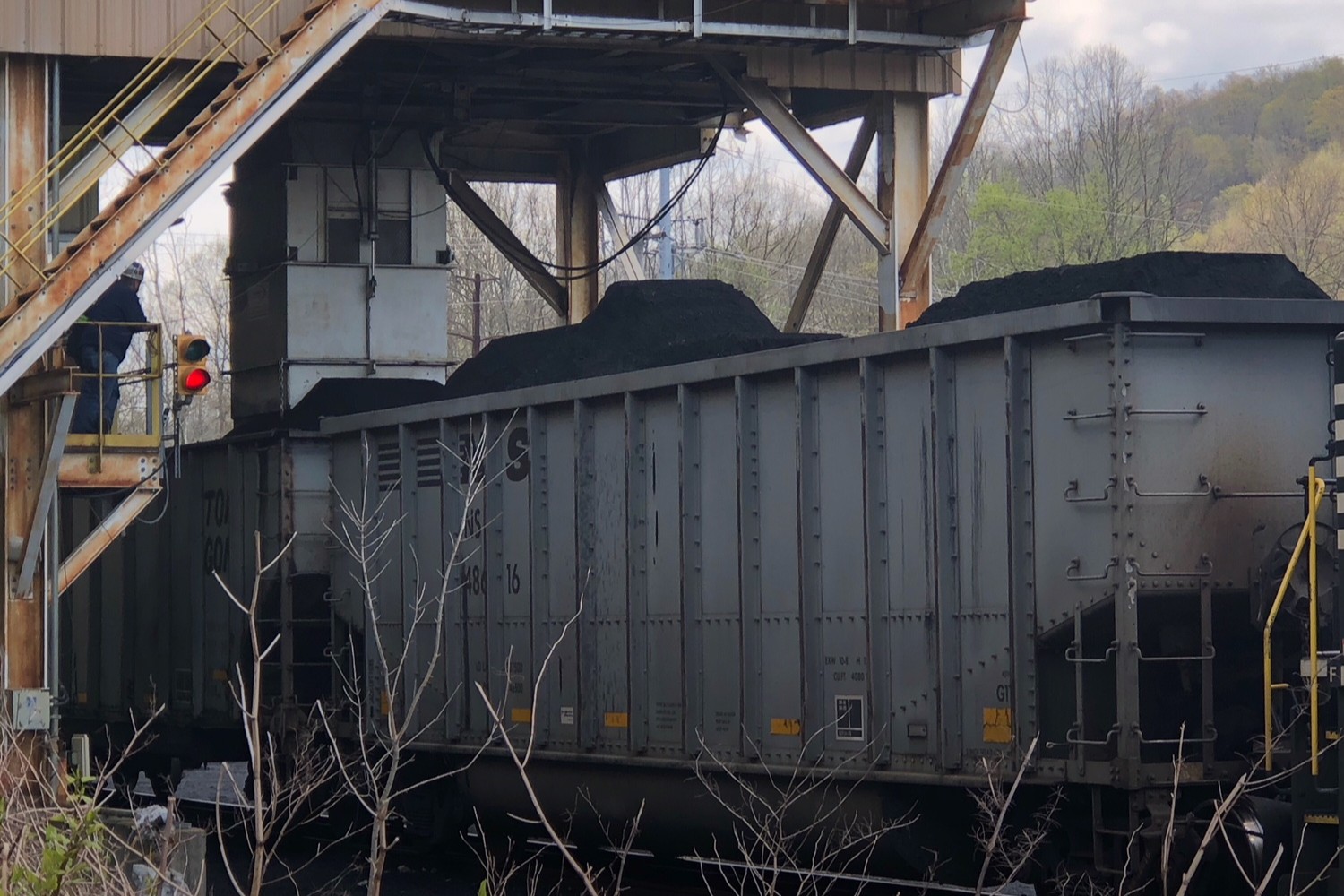
Establishing rail service to AlphaMet's new coal mine in West Virginia helped take 30,000 trucks off local roads and brought a much-needed economic boost to the area.

The Federal Railroad Administration (FRA) has published its Fiscal Year (FY) 2025 Annual Enforcement Report. The report discusses inspections and audits performed, enforcement actions recommended, civil penalty assessments and other cases in FY 2025.
In a press release issued by the FRA, the agency noted an overall 25% year-over-year increase in rail safety fines. Of the $21 million in fines issued, about $18 million was for rail safety law violations while the balance was for hazardous materials transportation law violations. The release also highlighted other data including that the FRA conducted over 70,000 safety compliance inspections and closed about 3,900 cases.
Along with the annual enforcement report, the FRA also re-posted its 2023 Civil Penalties Schedules & Guidelines document identifying rules and penalty amounts under Title 49 of the Code of Federal Regulations (CFR). The table shows the section of 49 CFR where the rule is found, offers a brief description of the potential violation and identifies a guideline penalty amount.
In its efforts to increase transparency and accountability, the Surface Transportation Board (STB) unveiled a new case status webpage showing the current stage of all proceedings before the agency.
The Case Status page identifies the docket number, docket title, date of expected next action and current status of the docket. Users can search the dockets or filter them by current status. The STB expects to update the page on a weekly basis, noting recently filed dockets may not appear immediately on the list.
The Case Status page joins other efforts by the STB to increase transparency. A month ago the agency launched a beta version of its Open Data Portal to allow easier access to the STB’s data catalog, which compiles Class I railroads’ rail service data reports. The STB has also improved its records search page to make it easier for users to find records, save search results, export lists and more.
In other news, Richard Kloster was sworn in on June 5 as the newest STB member. Kloster previously served as president and founder of transportation consulting company Integrity Rail partners. He was confirmed by the Senate on May 18 and his term ends Dec. 31, 2028.
The Wisconsin Department of Transportation (WisDOT) seeks feedback on the draft Public Involvement Plan (PIP) of its 2027 State Freight Plan. Comments are due July 17.
The PIP describes objectives for public and stakeholder outreach concerning the Wisconsin State Freight Plan. Gathering public comments on the PIP is one of the initial steps in the stakeholder outreach process. WisDOT expects the State Freight Plan to be finalized in 2027.
The National Transportation Safety Board (NTSB) recently announced it has launched an enhanced version of its Case Analysis and Reporting Online query tool, known as CAROL.
CAROL is a search platform allowing the public to look for the NTSB’s investigative data and safety recommendations across all modes of transportation. The NTSB calls its upgraded version of CAROL “a clearer, faster, and more intuitive way for the public, media, investigators, and researchers to search, filter, and review NTSB’s information.”
New features include the ability to save custom searches, share links to saved searches, use a personalized dashboard and more. There are also searchable data fields allowing for more targeted research and analysis.

Last week, the House Committee on Energy and Commerce’s Environment Subcommittee held a hearing to advance a package of bills that included the LOCOMOTIVES Act introduced by Representative John Moolenaar (R-Mich.).
ASLRRA supports the LOCOMOTIVES Act, which would prevent states from imposing environmental standards on locomotives and locomotive engines that are stricter than those of the federal government. Specifically, the bill eliminates the provision in the Clean Air Act allowing the California Air Resources Board (CARB) to request waivers from the Environmental Protection Agency (EPA) to allow for stricter emissions standards.
In advance of the hearing, ASLRRA submitted into the record a letter of support for the LOCOMOTIVES Act. The letter emphasizes the importance of a consistent national regulatory framework and highlights the potential negative impact of state-specific rules like the In-Use Locomotive Regulation proposed by CARB in 2023. The letter also urges Congress to support the bill.
On June 3, the House Appropriations Committee passed H.R. 9170, the Fiscal Year (FY) 2027 Transportation, Housing and Urban Development (THUD) funding bill by a vote of 34 to 27. The next stop for the bill is the House Rules Committee, en route to the House floor sometime in June or July. The text of all amendments offered during the markup of the bill can be read here.
As a reminder the bill included funding recommended by the House THUD Subcommittee. Items relevant to railroads include:
A bipartisan managers amendment offered by THUD Subcommittee Chairman Steve Womack (R-Ark.) on behalf of himself and Ranking Member Jim Clyburn (D-S.C.), which was agreed to by voice vote without debate, did add report language urging the U.S. Department of Transportation (USDOT) to process grant awards quickly and according to government-wide guidance as well as report language urging outcome-based reviews of federal regulations.
In addition, an en bloc GOP amendment was adopted by voice vote which also adds report language directing the USDOT to continue testing transportation workers for all controlled substances including marijuana.
Within the House Report language, the Committee directs the FRA research and development program to spend $2.75 million “to continue to improve safety practices and training for class II and class III freight railroads, including efforts to improve the safe transportation of hazardous materials, other freight, and passenger rail.”
Prior to the completion of his spring internship with the government affairs team, Chris Konstantopoulos shared a written reflection on his experience. His thoughts were in response to a question posed to him by ASLRRA Vice President, Congressional Affairs Nicole Brewin.
Brewin’s question and Konstantopoulous’s response, which was edited for length and clarity, are below.
Brewin: Political science courses often present policymaking as a structured and orderly process. From your experience interning this spring in transportation policy, how does the reality of drafting and advancing policy on Capitol Hill differ from what students learn in the classroom?
Konstantopoulous: During the spring semester, I took a policymaking course that focused on the traditional stages of the policy process: problem identification, policy formulation, policy adoption and policy evaluation. In class, policymaking was presented as a fairly structured and sequential process. We learned how lawmakers identify issues, draft legislation, debate potential solutions, pass bills through Congress and ultimately evaluate whether a policy achieved its intended outcome.
My internship this spring at ASLRRA showed me that the real-world process is much more complicated and unpredictable. While the stages we studied in class do exist, the actual work of developing and advancing policy on Capitol Hill is far less orderly than textbooks suggest. Policymaking involves constant negotiation, changing priorities, political strategy, and long hours behind the scenes.
One experience that stood out to me was attending a House Transportation and Infrastructure Committee markup. I was there from 10 a.m. until 3 p.m., and the committee continued working until nearly 4 a.m. Watching lawmakers debate amendments in real time showed me just how lengthy and demanding the legislative process can be. The experience gave me a much deeper appreciation for the complexity of policymaking and the persistence required to move legislation forward.

ASLRRA’s first-ever Fall Super Regional Meeting will take place Oct. 5-7 in St. Louis, Missouri, combining the Association’s region meetings, the Finance and Administration Seminar and the General Counsel Symposium.
ASLRRA welcomes organizations interested in sponsoring this year’s inaugural event. Sponsorships are available at a range of price points. Visit ASLRRA’s website to learn more about each sponsorship level and the associated benefits. Contact meetings@aslrra.org to ask questions or purchase a sponsorship.
Registration is also open for the meeting, as is ASLRRA’s hotel room block at the St. Louis Union Station Hotel.

Loram offers discount pricing on its Aurora Track Inspection Technology providing comprehensive tie inspections generating detailed reports allowing railroads to streamline capital maintenance programs and ensure they are in line with industry regulations with compliance reports.
Click here to learn more about ASLRRA’s Member Discount Program and view all available products and services, or contact ASLRRA’s Sabrina Waiss for more information about becoming a Preferred Provider.
In collaboration with subject matter experts and members of the Association’s Safety & Training Committee, ASLRRA has cultivated and produced a collection of drug & alcohol educational materials, available exclusively to members for their own internal use, at no cost.
Materials may be used to assist and educate railroads, contractors, and employees about FRA regulations/procedures (49 CFR Parts 40 and 219) and required compliance practices and testing. Resources include downloadable posters, forms and brochures and on-demand webinar recordings. Members can log in to access all available materials and resources on ASLRRA’s website.
Log in at the link above to view these resources.
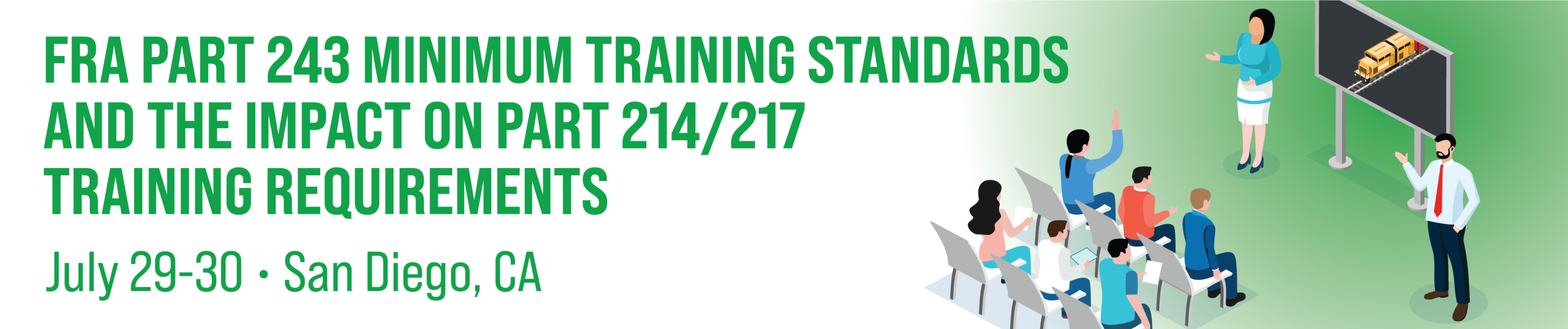
Few spots remain! FRA Part 243 Minimum Training Standards Training Seminar
July 29-30, San Diego, California
Speakers will offer an in-depth review and discussion of Part 243 Minimum Training Standards and address how Part 243 interacts with training requirements of Part 214 Roadway Worker Safety and Part 217 Efficiency Testing.
Click here to see additional upcoming seminars as well as event details and online registration and hotel booking links.


ASLRRA welcomes summer intern Levente Toth. He will work with the Association’s government affairs team until July 24.
Toth comes to ASLRRA through The Fund for American Studies, an organization that provides opportunities for students in the U.S. and from around the world to learn about American democracy through internships and other programs.
“The rail industry interests me because it is vital for so many other businesses to operate,” said Toth. “Through this internship, I would like to better understand what lobbying and government affairs mean in real life. I also hope to participate in as many in-person professional events as possible, learn more about how policy, infrastructure, and business intersect and build long-term professional connections through the community-building parts of the fellowship.”
Toth is from Budapest, Hungary, and currently studies international business economics at Cornivus University of Budapest. This is Toth’s second time in the U.S. He previously spent a month visiting major cities including Indianapolis, Chicago and Philadelphia. Toth hopes to start his own business when he completes his studies. In his spare time, Toth enjoys running and playing American football.
ASLRRA welcomed a special guest speaker from the Federal Railroad Administration (FRA), Senior Policy Advisor Russell (Rusty) Roberts, to last week’s Designated Supervisor of Locomotive Engineers (DSLE) training seminar in Freeport, Maine. Roberts delivered remarks on the second day of the seminar.
In his presentation, Roberts discussed the importance of industry safety and training, the value of interactive, engaging training opportunities and the overall importance of the CRISI grant program in helping organizations meet rail industry development and safety goals. Roberts pointed to the successful launch of the CRISI-funded Short Line Training Center and the number of railroads benefitting from computer-based training available on the Learning Management System (LMS) platform. He also highlighted instructor-led, in-person training seminars offered by ASLRRA, plus the Mobile Technical Training Center delivering on-site locomotive simulator training to railroads throughout the U.S.
Roberts spoke of his desire to see the Short Line Training Center continue its important work by applying for a fiscal year 2026 CRISI grant, and encouraged all short line railroads to pursue a portion of the grant funds available under the current cycle. After he spoke, Roberts sat in on part of the DSLE training seminar and participated in an audience Q&A with presenters from the FRA, ASLRRA and Iowa Northern Railway Company.
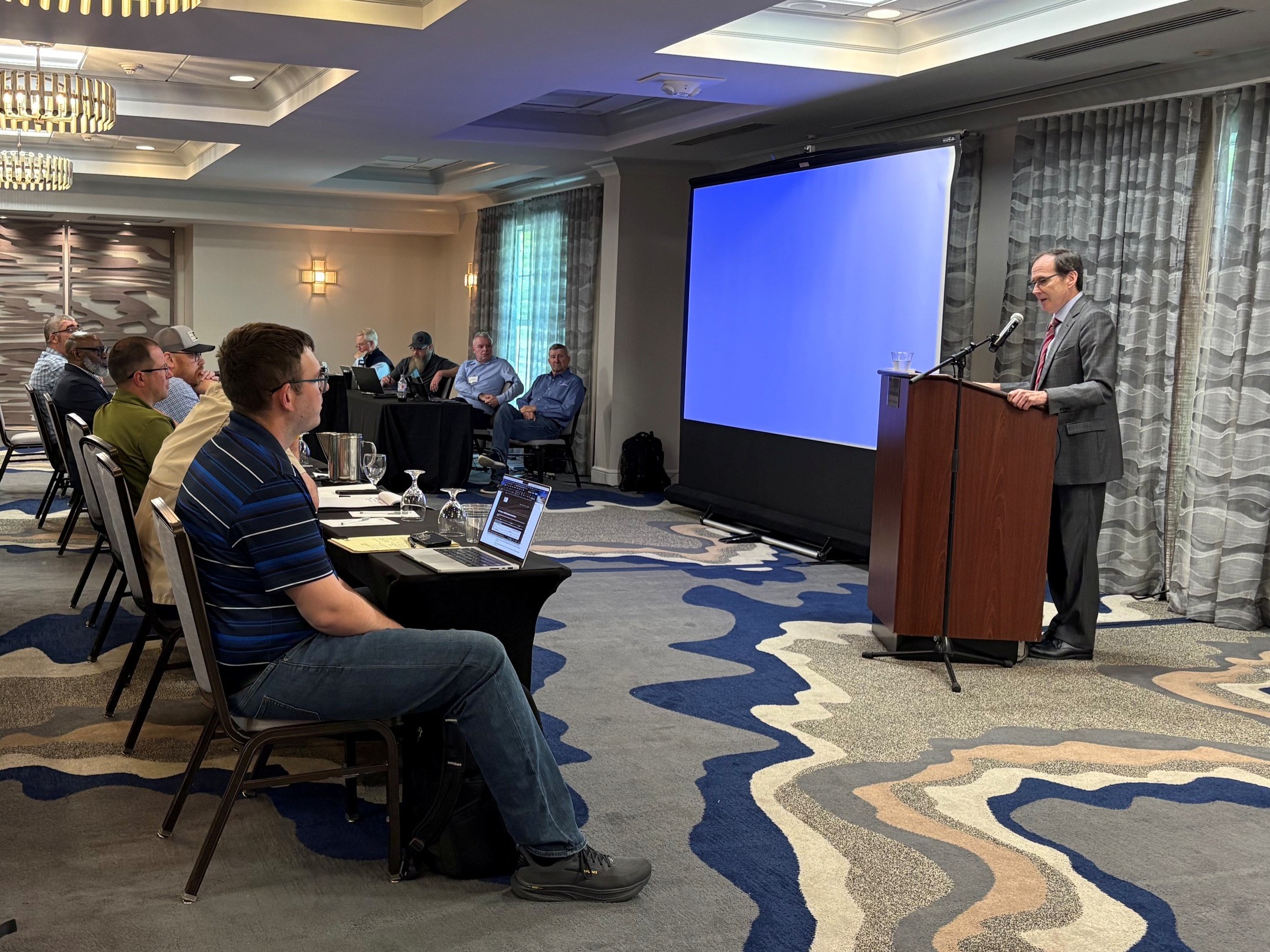
FRA Senior Policy Advisor Rusty Roberts (at podium) was a guest speaker at ASLRRA's DSLE training seminar last week in Freeport, Maine.

In the June issue of Railway Age magazine, Chuck Baker discusses freight rail safety, focusing on how it continues to improve thanks to industry collaboration, technological advancements and a shared concern for the well-being of employees and the community.
This month’s ASLRRA Perspective shares rail safety data from 2025, noting that safety has improved across nearly every major category. In addition, in 2025, short line railroads received a record number of Jake Awards and Jake Awards with Distinction for below-industry-average injury rates – injury rates that have dropped by 3% in each of the past two years.
Baker discusses some of what lies behind those improvements, including infrastructure improvements funded by the 45G short line infrastructure tax credit and Consolidated Rail Infrastructure and Safety Improvements (CRISI) grant funding, as well as work done by the Short Line Safety Institute (SLSI).
Technology is also helping improve safety, and railroads are eager to explore ways to improve railroad operations while supplier companies are constantly developing new offerings. Altogether, notes Baker, these efforts are having a significant positive effect on industry safety.
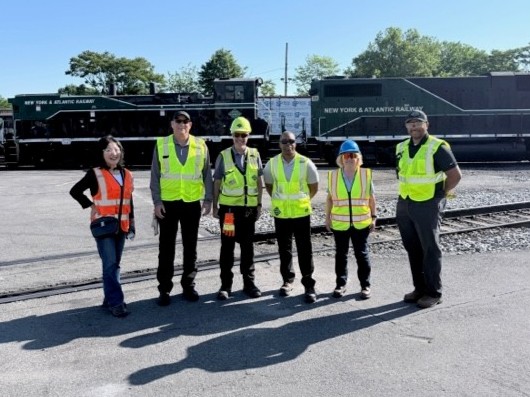
Last week, Jo Strang (second from right) participated in a site visit to ASLRRA member New York & Atlantic Railway to aid in a research project with the Pipeline and Hazardous Materials Safety Administration (PHMSA). The project involved helping technology company Newport Sensors identify locations for hazard detection on tank cars. Short Line Safety Institute (SLSI) Executive Director Tom Murta (second from left) also participated.
This week, Chuck Baker traveled to Fort Worth, Texas this week for a meeting of the BNSF Shortline Caucus. The caucus, which was established to improve communication between BNSF and its connecting short line railroads, includes 14 short line members and Baker.

ASLRRA maintains an industry calendar featuring events that may be of interest to members. If you have an industry event you would like included on the calendar and possibly in Views & News, please send relevant event details and links to Mariel Takamura for consideration.
The Short Line Safety Institute (SLSI) has published a new Safety Message focused on hurricane preparedness.
With hurricane season in effect from June 1 to Nov. 30, SLSI urges railroads in storm zones to review steps they can take to prepare for a hurricane in advance and make a plan for recovery afterward. SLSI’s Safety Message includes tips and best practices for before, during and after a hurricane. Also listed are helpful websites and apps that offer real-time weather alerts, list emergency shelter locations and basic preparedness strategies, show storm surge maps and flooding information and more.
This Safety Message is one of the many Safety Tips and Hazmat Tips SLSI offers on its website. The PDF format is meant to allow for easy printing and sharing in common areas and safety briefings. There are also a variety of short informational videos, templates, self-guided tools and other resources available online.
To receive updates and news from SLSI, join their mailing list by filling out the subscription form at the bottom of their website.
Registration is open for the Women in Rail Conference hosted by Railway Age and Railway Track & Structures (RT&S) magazines. The fourth-annual event will take place at the Hyatt Regency Schaumburg in Schaumburg, Illinois. Click here to learn more and register.
Confirmed speakers include CSX’s Maryclare Kenney and CPKC’s Pam Arpin. The event will also feature panel discussions and networking opportunities. An awards luncheon will also recognize the 2026 Women in Rail, Women in Rail Engineering and International Railway Journal’s Women in Rail winners.
Views & News is published by American Short Line and Regional Railroad Association.
Please contact Mariel Takamura, associate editor, with questions or comments.


