
M&E, Skunk Train unveil locomotives to celebrate U.S. 250th
A 140-year-old rail line through Sioux Falls could soon get a $35 million facelift
Railroad members! If you want to be featured in this section, please email us the link. You can also tag us (@ASLRRA) in your social media posts. Interested in seeing your railroad showcased in your local newspaper? Contact Amy Krouse for assistance.
The National Transportation Safety Board (NTSB) requested ASLRRA share information about the NTSB’s May 18, 2026, report Canadian Pacific Kansas City Railroad Derailment with Subsequent Hazardous Materials Release and Fire, Bordulac, North Dakota, July 5, 2024 (NTSB/RIR-26-07).
ASLRRA has been asked to inform our members of the circumstances of the derailment and encourage members to review and, if necessary, revise their culvert inspection procedures to align with guidance from the American Association of State Highway and Transportation Officials (AASHTO) in its Culvert & Storm Drain System Inspection Guide.
A copy of the information from the NTSB can be found in PDF form here.
Better Culvert Inspections Can Prevent Track Bed Failures
Though usually less visible than bridges, culverts underneath railroad tracks are important elements of railroad infrastructure and must be maintained to ensure the structural integrity of the tracks above them. The National Transportation Safety Board (NTSB) wants to inform railroads about the importance of thorough culvert inspections to identify problem areas before they lead to track bed failure.
Derailment and Earlier Track Bed Failure
The NTSB investigated a July 5, 2024, accident in which Canadian Pacific Kansas City Railroad (CPKC) freight train 242-03 derailed 29 railcars, including 17 hazmat tank cars, near Bordulac, North Dakota. Flammable hazardous materials were released from some of the derailed tank cars and led to a fire, which then resulted in the release of anhydrous ammonia from other derailed cars.
The NTSB determined that a degraded concrete drainage culvert underneath the track had caused the loss of ballast and material from the track bed, leading to a subgrade void. As train 242-03 traversed this area, the track bed void suddenly collapsed, causing a severe dip in the rails and the derailment.
About a year before the accident, in the same section of track as the derailment, a maintenance crew saw the track bed suddenly give way while tamping. The crew repaired the track bed, but noted the culvert beneath the tracks was filled with ballast and subgrade material. This culvert was right next to the culvert over which train 242-03 derailed in July 2024. The culverts were installed in 1913.
What Can Railroads and Industry Do?
Although CPKC’s inspection frequency was sufficient, their inspection methods were not. Typically, inspectors looked into culverts from their ends, and this narrow and limited viewing angle did not allow them to fully assess or quantify the culverts’ conditions. We [NTSB] recommended that CPKC revise its culvert inspection procedures to require culverts to be inspected internally, either on foot when safe or by using technology, such as cameras or remotely operated vehicles.
Inspectors also lacked established criteria to assess the condition of culverts and effectively describe what they found. The American Railway Engineering and Maintenance-of-Way Association’s Manual for Railway Engineering, which includes recommended inspection practices, refers railroads to the American Association of State Highway and Transportation Officials’ Culvert & Storm Drain System Inspection Guide for details about culvert inspection items and techniques and comprehensive condition rating systems. We [NTSB] also recommended that CPKC revise its culvert inspection procedures to provide detailed rating guidance, specific to each type of culvert construction, similar to the Culvert & Storm Drain System Inspection Guide, and require remedial actions to be taken within set timeframes, when necessary.
Like the culverts at the accident location, many railroad culverts have been in service for decades (or longer). Therefore, railroads should
Additional Information
More information about the Bordulac accident, including the final report, Canadian Pacific Kansas City Railroad Derailment with Subsequent Hazardous Materials Release and Fire, Bordulac, North Dakota, July 5, 2024, can be found on the NTSB website at www.ntsb.gov, railroad investigation RRD24LR012.

The Association recently filed comments with the Surface Transportation Board (STB) regarding replies to replies and the Cybersecurity and Infrastructure Security Agency (CISA) concerning reporting requirements under the Cyber Incident Reporting for Critical Infrastructure Act (CIRCIA).
ASLRRA’s comments to the STB concern an advance notice of proposed rulemaking (ANPRM) in Docket No. EP 790. The proposed rulemaking evaluates revising rules governing replies to replies, also known as rebuttals, in STB proceedings.
After evaluating the proposals presented in the ANPRM, ASLRRA is supportive of the third option proposed by the Board, that it should amend 49 CFR § 1104.13 to allow rebuttals but limited to matters raised on reply, and require that they be submitted within a certain timeframe.
This option is consistent with other federal agency proceedings and preserves procedural efficiency by avoiding superfluous additional briefing. Moreover, ASLRRA recommends that in the interest of efficiency, the Board should not allow surrebuttals, or responses to rebuttals.
ASLRRA submitted supplemental comments to CISA as a follow-up to testimony provided by Association Vice President, Data Technology and Security Fred Oelsner during a virtual town hall meeting on June 16. The meeting, hosted by CISA, discussed the notice of proposed rulemaking on CIRCIA reporting requirements.
In the comments, ASLRRA advocates that CISA refine and narrow the definition of “covered entities” and clarify that third-party reporting should only be required for systems deemed by railroads to be critical to their operations as railroads, consistent with TSA’s applicability criteria.
Virginia’s Commonwealth Transportation Board has approved the Six-Year Improvement Program for the Virginia Department of Transportation and Department of Rail and Public Transportation (DRPT). The program allocates $28.5 billion to over 4,300 transportation projects over the next six fiscal years (FY), starting July 1, 2026.
The program designates over $19 million in funding for the Commonwealth Rail Fund, which includes the Freight Rail Enhancement to Increase Goods and Highway Throughput (FREIGHT) grant program and statewide rail planning. DRPT also identifies $11.7 million in FY 2027 for the Shortline Railway Preservation Fund, with an additional $24.5 million through FY 2028-2032. A list of FY 2027 rail projects can be found in the complete Six-Year Improvement Program document online.
The Federal Railroad Administration (FRA) has posted an Occupational Category Table Template to help railroads track training and qualifications for various railroad employees. Railroads are required to track this information.
According to the FRA, employers can edit or adapt the document to fit their occupational categories and training needs. The agency points out that safety-related railroad employees must receive training and qualification on every relevant railroad federal safety law, regulation or order they are expected to apply in connection with their duties. It is the employer's responsibility to ensure employees are properly trained and qualified.

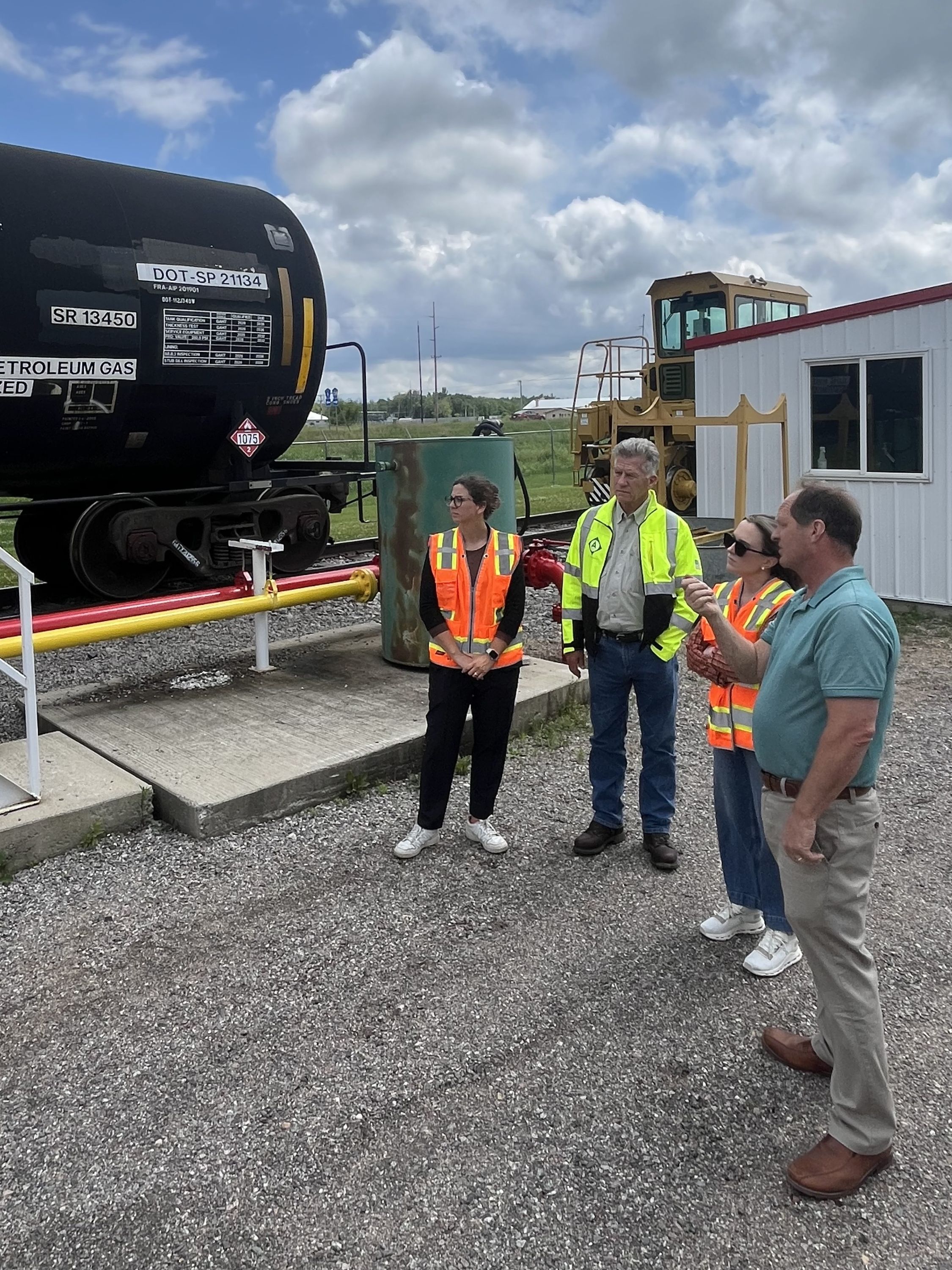
Top Left: Rockville Propane Terminal President Pat Wenner (far right) discusses rail service at his facility with Congressman Tom Emmer's District Representative Shelby Novotny (far left) and Chief of Staff Taylor Reaves (second from right). They were joined by Anacostia Rail Holdings President and CEO Peter Gilbertson (second from left).
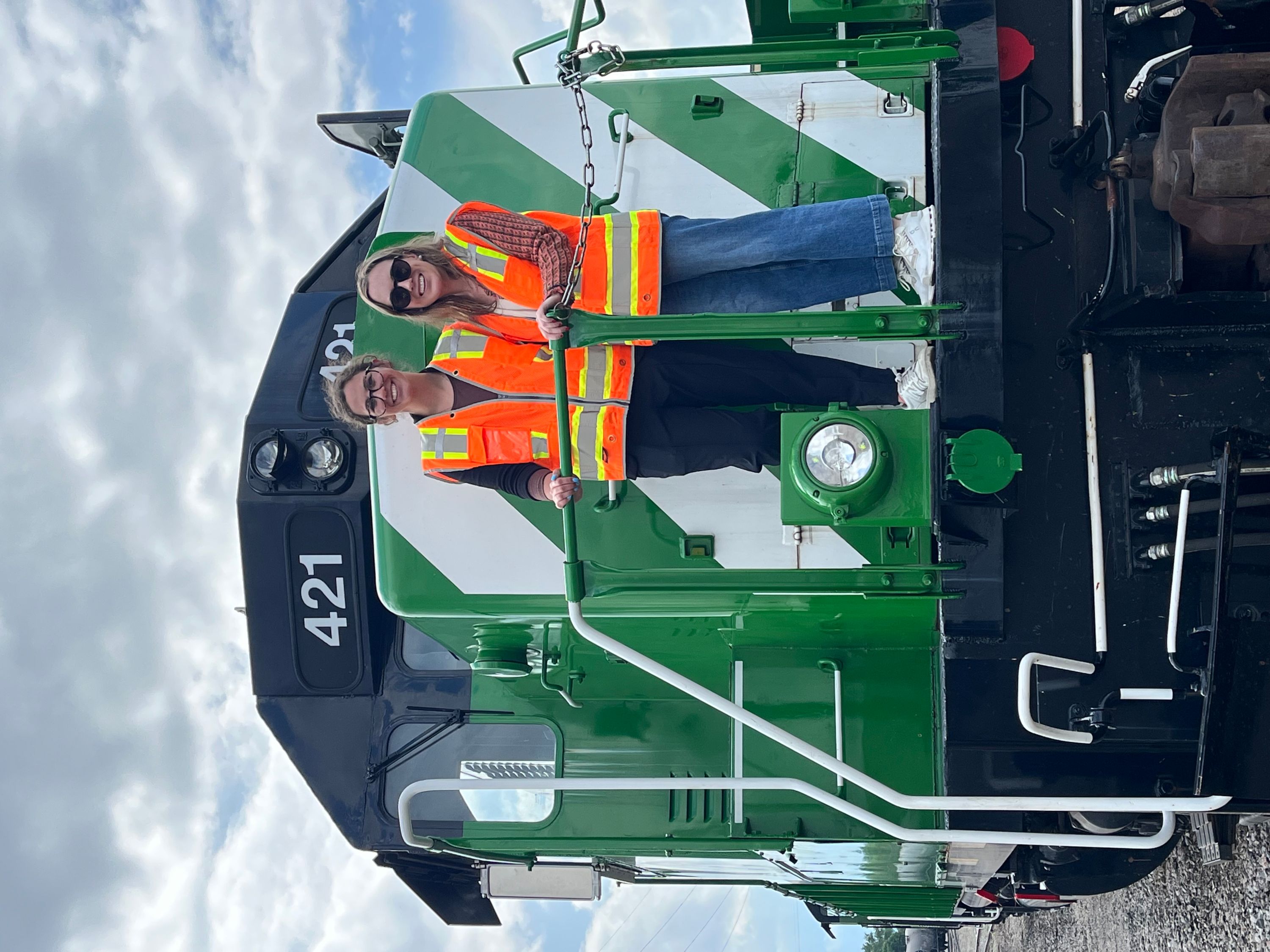
Top Right: As part of their tour, Novotny (left) and Reaves rode a Northern Lines Railway locomotive in NLR's St. Cloud railyard.
On June 17, ASLRRA member Northern Lines Railway (NLR) hosted Taylor Reaves and Shelby Novotny, chief of staff and district representative, respectively, for Congressman Tom Emmer (R-Minn.), who is House majority whip. Their visit was meant to inform a letter of support for a Consolidated Rail Infrastructure and Safety Improvements (CRISI) grant application being submitted by NLR.
NLR parent company Anacostia Rail Holdings President and CEO Peter Gilbertson, NLR General Manager Jim McDonald and Rockville Propane Terminal President Pat Wenner hosted Reaves and Novotny. During their visit, Reaves and Novotny toured the facility of Rockville Propane Terminal, an NLR customer, learning about the importance of rail service to local businesses. They also rode a hi-rail to see the conditions of NLR’s line and took a short locomotive ride in NLR’s St. Cloud yard.
NLR hopes to host Congressman Emmer himself later this summer.
While ASLRRA’s government affairs team works daily to cultivate relationships with legislators and their staff to advocate on behalf of the short line freight rail industry, nothing is more important to the Association’s outreach effort than constituent relationships with their federal and state lawmakers. There are many ways ASLRRA members can increase positive exposure to the short line industry and build or renew relationships with members of Congress in their home districts.
One of the best ways to achieve this exposure is to invite lawmakers to tour operations. Summer is an ideal time for lawmakers to visit railroad property, as many often return to their hometowns and take time to meet constituents.
Members looking for assistance connecting with their elected officials or setting up such a visit can reach out to ASLRRA’s government relations team – they are happy to help.
Yesterday and today, ASLRRA and members of the Association’s Legislative Policy Committee (LPC) held a fly-in to meet with members of Congress, advocating for passage of bills to modify the 45G short line railroad track maintenance credit.
For the two-day event, 25 participants took part in 18 meetings in the Senate and 39 in the House.
The bills, H.R. 516 and S. 1532, would update 45G by increasing the credit cap to $6,100 per mile, index the credit to inflation and extend credit eligibility to all short-line-owned track miles. Since its inception in 2005, the tax credit has driven over $8 billion in private infrastructure investment.
Senators Mitch McConnell (R-Ky.), Richard Blumenthal (D-Conn.) and Lisa Murkowski (R-Alaska) are the most recent cosponsors of S. 1532, bringing the total to 46. The House bill has 170 cosponsors, with Representatives John Joyce (R-Pa.) and Bobby Scott (D-Va.) the most recent additions.
To learn more about 45G and its importance to the short line freight rail industry, see ASLRRA’s 45G Short Line Tax Credit Modernization webpage. Also on the page are other resources including maps showing current bill cosponsors, 45G success stories and more.


Continental Rails, Inc. is a premier railroad and rail bridge contractor that has been in business for over 20 years, operating all across the lower 48 state. Continental Rails builds, repairs and maintains America’s railways and bridges to keep industries and products moving. For inquiries, please contact Eric Reynolds, Superintendent, Track Division or Lee Shoemake, Superintendent, Bridge Division.
Shel-Bar Electronic Industries is a North American security technology integrator specializing in rail, transportation and critical infrastructure environments, recognized for its commitment to quality, attention to detail and long-term customer support. Drawing on decades of field experience supporting rail operators, Shel-Bar developed ImpactEye™, an onboard event capture ecosystem that synchronizes video, operational data and locomotive metadata to enhance safety, accountability and incident review. Through a commitment to innovation and lasting customer partnerships, Shel-Bar helps railroads gain greater visibility into their operations both onboard and across their infrastructure.

ASLRRA’s Fall Super Regional Meeting brings together railroad professionals for high-impact education and networking. This year’s program features dynamic panels, keynote speakers, expert-led sessions and interactive breakouts designed for peer-to-peer learning.
Attendees may also join the General Counsel Symposium sessions. CLE credit is included in event registration fees, but individuals must add the credit when they register. Courses offer 7.1 hours (50 min states) or 5.9 hours (60 min states).
Explore the General Counsel Symposium course list here.
Register and secure your hotel by July 18 to lock in the best rates.
ASLRRA welcomes organizations interested in sponsoring this year’s inaugural event. Visit ASLRRA’s website to learn more or contact meetings@aslrra.org to ask questions and purchase a sponsorship.

Aon is the world’s leading enterprise solution for the most accurate and fair workforce assessments at scale, powered by deep science, workforce data, and industry knowledge. A pioneer in the industry, Aon designs and implements assessments for pre-hire and post-hire purposes. Aon has direct experience developing value-adding assessments for railroad-specific frontline roles and job clusters.
Click here to learn more about ASLRRA’s Member Discount Program and view all available products and services, or contact ASLRRA’s Sabrina Waiss for more information about becoming a Preferred Provider.
New Designated Supervisor of Locomotive Engineers (DSLE) Course Added
The Short Line Training Center has launched a brand-new Designated Supervisor of Locomotive Engineers (DSLE) computer-based training program on the Learning Management System (LMS). The new course is derived from the popular in-person training course of the same name.
This comprehensive course equips current and aspiring DSLEs with the knowledge required under 49 CFR Part 240 and key elements of Part 242, ensuring railroads stay compliant and confident in their engineer oversight practices.
Click here to learn more about the Short Line Training Center and view a complete list of available online and in-person training programs.
Room block deadline extended to June 24! Only a few spots are left in this seminar!
Leadership Program Professional Trainer Development
July 14-16, Charlotte, North Carolina
The training is intended for anyone who teaches, trains, or leads others and who would like to become a more confident presenter and more skilled in designing training for adult learners. Whether just starting as a presenter or instructor or having led training for decades, this course will level up skills for delivering exceptional training in a range of settings, from the classroom to the railyard.
Course content includes designing training using adult learning principles, managing participant engagement and the learning environment, enhancing personal presentation skills, and developing course materials using Bloom’s Taxonomy for Instructional Design and ADDIE methods.
Click here to see additional upcoming seminars as well as event details and online registration and hotel booking links.

The Kansas Department of Transportation announced it will begin accepting applications on June 29 for its Rail Service Improvement Program. Submissions are due Aug. 31.
Approximately $10 million will be available for projects that enhance safety, economic efficiency and sustainability on the state’s rail network. This is no minimum or maximum project amount, but applicants must provide a total project cost match of 30%.
Eligible entities include Class II and III railroads, any Kansas port authority and owners or lessees of industry tracks adjacent to Class II or III railroads. Click here to view the Rail Service Improvement Program website and find links to apply.

Sarah Yurasko and ASLRRA legal intern Emeline Stewart attended the Association of Transportation Law Professionals (ATLP) 97th Annual Meeting in Baltimore, Maryland. They heard from members of the Surface Transportation Board and Federal Railroad Administration representatives and joined educational sessions on automated vehicles and the Union Pacific and Norfolk Southern proposed transaction.

ASLRRA maintains an industry calendar featuring events that may be of interest to members. If you have an industry event you would like included on the calendar and possibly in Views & News, please send relevant event details and links to Mariel Takamura for consideration.
In early June, ASLRRA member Palmetto Railways partnered with the Short Line Safety Institute (SLSI) for a week-long hazardous materials (hazmat) training event. Participants included 21 Palmetto Railways employees and 69 first responders from 10 local groups.
SLSI provided training at no cost to the participants, who represented the Charleston County Emergency Management Division, Charleston Fire Department, Goose Creek City Fire Department, Moncks Corner Fire Department, North Charleston Fire Department, Central Berkeley Fire & EMS, North Berkeley Fire Department, South Berkeley Fire Department, Bonneau Rural Fire Department and HEPACO.
After receiving instruction in rail-focused hazardous materials incident response, the group participated in a field exercise. At the week’s end everyone applied their lessons to a realistic rail emergency scenario that required significant coordination and communication between railroad personnel and first responders.
This training, funded through a grant from the Pipeline and Hazardous Materials Safety Administration (PHMSA), not only improves knowledge of hazmat response, it helps create and strengthen relationships between railroads and local agencies that are critical in the event of an actual incident on railroad property.
Railroads interested in taking advantage of SLSI’s hazmat training programs can learn more here or contact SLSI directly via email at hmit@shortlinesafety.org.
Special Training Opportunity Available through SLSI
SLSI is also offering its in-person Leading Forward – Skills Development for Railroad Professionals training seminar August 11-13 in Oklahoma City, Oklahoma. The leadership course will be followed by a brief hazmat training program. It is the first time both events are being offered together. There are limited spots remaining in the course. Click here to register today.
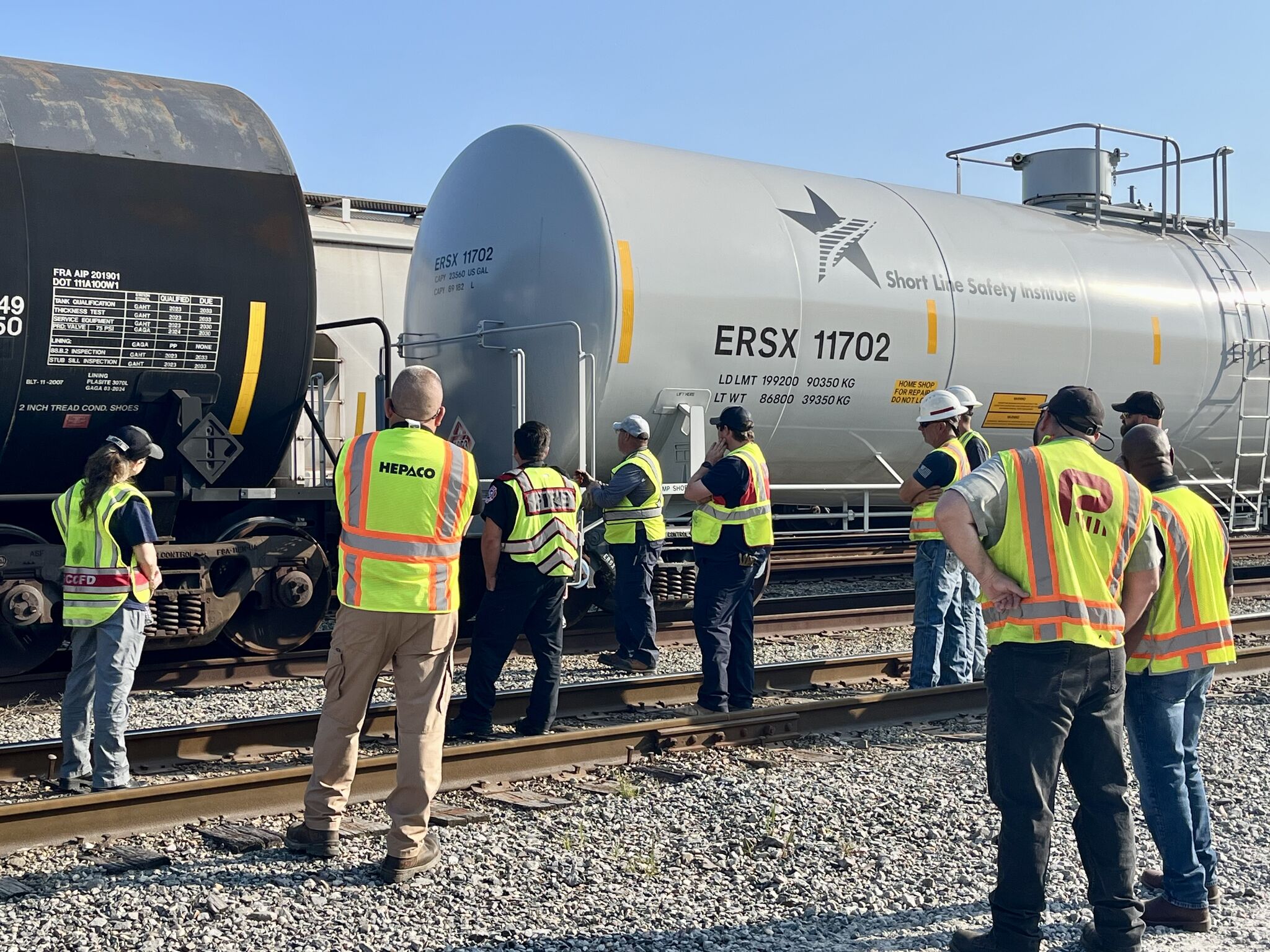
Palmetto Railways recently held a week-long hazmat training event with the Short Line Safety Institute (SLSI). SLSI's team of experts trained 90 people, including employees of Palmetto Railways and representatives from 10 local first responder agencies.
Today Operation Lifesaver, Inc. (OLI) observed the second-annual ENS Sign Awareness Day, meant to help the public recognize and know how to use blue and white Emergency Notification System (ENS) signs located at railroad crossings.
“Although the sign is small, its importance is huge,” said OLI Executive Director Rachel Maleh. “ENS Sign Awareness Day shares vital knowledge that can make all the difference in an emergency. Knowing where to find information and how to act quickly can prevent a tragedy.”
State Operation Lifesaver organizations, railroads, first responder agencies, safety and transportation stakeholders and many others held in-person events, shared messages about the ENS sign with local news and radio stations and engaged online throughout the day.
The ENS sign displays a unique phone number and crossing identification number that can help the public directly contact a railroad dispatcher if there is an emergency on tracks at the crossing. If a vehicle gets stuck on tracks, OLI reminds people to:
EUCI is offering an online course in Railway Construction Management, taking place Oct. 21-22. The course will cover project planning, delivery and execution, combining information about railway infrastructure with construction management fundamentals. Use the link above for more information and to register.
Views & News is published by American Short Line and Regional Railroad Association.
Please contact Mariel Takamura, associate editor, with questions or comments.


