
R.J. Corman Teaming With Strata Platforms on Industrial Development
All Aboard! Adirondack Railroad Looking for Polar Express Performers
Railroad members! If you want to be featured in this section, please email us the link. You can also tag us (@ASLRRA) in your social media posts. Interested in seeing your railroad showcased in your local newspaper? Contact Amy Krouse for assistance.
ASLRRA, along with government partners such as the FBI, Cybersecurity and Infrastructure Security Agency (CISA), Federal Railroad Administration (FRA) and Transportation Security Administration (TSA), strongly recommend that short line railroads and technology service providers be aware of the heightened threat environment posed to U.S. critical infrastructure (CI), including relatively small targets like the Association’s members.
In recent weeks, there have been confirmed cyber attacks on water and wastewater service (WWS) providers in twelve states, as well as on the North Carolina Ports Authority (NC Ports), which operates the Ports of Morehead City and Wilmington, and Charlotte Inland Port. The attacks on the water and wastewater service providers appear to have led to no service impacts, but NC Ports was forced to delay gate openings and shift to manual processes as it worked to contain the intrusion.
These attacks highlight the vulnerability of operational technology (OT) in the field, with CISA issuing the following guidance around protecting OT:
U.S. organizations, including short line railroads and their service providers, are encouraged to report suspicious or criminal activity related cyber threats or incidents to:
Reach out to Fred Oelsner with any questions related to cyber security for ASLRRA.


The Federal Railroad Administration (FRA) has published a number of research documents, making them available in the agency’s eLibrary.
Of particular interest to short line railroads are Findings from a Preliminary Review of Switching Operations Training Needs and Ensuring the Safe Operation of Automated or Partially Automated Locomotives: The Role of Driver State Monitoring Systems.
The research on switching operations training came from a project to develop guidelines and trainings for switching operations and shoving movements in rail yards. The Transportation Research Board (TRB) identified a need for railroad worker safety research on switching operations and shove movements, and FRA data shows switching accounts for more than half of human factors cause codes. The project collected data to develop curriculum intended to supplement new-hire and recurrency training programs at railroads. Four main findings focus on longer training, the craft mentor role, craft representation and updated training materials.
The technical report covering safe operation of automated or partially automated locomotives is in response to a need for more effective solutions to mitigate the impact of states of reduced operator alertness. The report describes the results of a study of driver state monitoring (DSM) systems that observe operator behavior and provide warnings if a change in operator state is detected. DSM systems are available in the automotive industry, but in this study these systems were evaluated in the railroad environment to determine their effectiveness.
Other recent FRA research results and technical reports include
Yesterday, in a 2–1 decision, the 11th Circuit denied the consolidated petitions challenging the Federal Railroad Administration’s (FRA) 2024 Train Crew Size Rule, leaving the rule fully intact. The majority concluded that FRA acted within its broad statutory authority over railroad safety and reasonably explained its decision to establish a two-person crew as the default, while providing pathways for one-person operations.
The court rejected the broader petitioners’ arguments that FRA lacked statutory authority because it had not demonstrated that the two-person requirement was “necessary;” lacked sufficient empirical evidence linking crew size to safety; inadequately explained its departure from its 2019 position; failed to properly consider foregone labor savings; conflicted with Congress’s statutory Risk Reduction Program; or lost authority by failing to finalize the rule within the applicable timeframe.
Importantly, the majority held that FRA does not need statistical certainty before adopting preventive safety regulation. It credited FRA’s reliance on research, public comments, increasing train lengths, human-factor accident trends, PTC limitations and firsthand accounts concerning the safety role of second crewmembers. The majority reasoned that requiring FRA to wait for sufficient one-person-crew accidents to establish statistical certainty would undermine the preventive purpose of railroad safety regulation.
For short lines, however, the rule continues to preserve materially greater flexibility than applies to Class I railroads through the notice and legacy pathways.
ASLRRA is reviewing the decision and evaluating options.
The Connecticut Department of Transportation (CTDOT) announced it has released a draft of the Connecticut Statewide Freight Plan, inviting the public to review and submit comments on the document. Comments are due Sept. 4.
The plan guides Connecticut’s future transportation investments and policy decisions. It describes the current state of Connecticut’s freight system and evaluates future transportation needs. A copy of the draft plan is available here, while CTDOT’s Freight Program website is here.
The Railroad Retirement Board’s August edition of its monthly Q&A series offers a comparison of benefits under railroad retirement and social security. The Q&A shows differences in rates payable at the close of the fiscal year (FY) ending in 2025.
Annuities paid under the Railroad Retirement Act are generally higher than those paid under the Social Security Act, especially for railroad employees with 30 or more years of creditable railroad service. The average age annuity for career railroad employees was $4,565 per month at the end of FY 2025. For all retired railroad employees the average payment was $3,640. Under social security, the average payment was $1,985.
The difference in payments is due to additional retirement taxes paid by employers and employees covered by the Railroad Retirement Act. The Q&A also compares disability, survivor and lump-sum death benefits and explains eligibility based on age.
The Surface Transportation Board (STB) announced Karen Hedlund has been confirmed to a second term as a board member. Her term will expire Dec. 31, 2030.
Hedlund’s first term expired in 2025. She was serving in a 12-month holdover period while awaiting renomination and Senate confirmation. Hedlund will continue to serve with three other STB members, Chair Patrick Fuchs, Vice Chair Michelle Schultz and Richard Kloster.

Last week the Senate passed a continuing resolution to extend government funding through Dec. 11. The Senate also passed an extension of the current surface transportation reauthorization bill, which would also be in effect through Dec. 11. Both government and surface transportation funding were set to expire on Sept. 30.
These extensions will now go to the House. They will not be considered until House members return from their recess in the first week of September.
The surface transportation reauthorization extension continues authorized funding but not any advanced appropriations. Right now, ASLRRA’s government affairs team is focused on meeting with elected officials about surface transportation policy priorities. Included on this list are truck size and weight issues and Consolidated Rail Infrastructure and Safety Improvements (CRISI) grant funding.
ASLRRA member parent company R. J. Corman Railroad Services recently welcomed elected officials to two sites on their network, showing the impact short lines have on the economy and their communities and discussing key issues like the 45G short line infrastructure tax credit.
Representative Morgan McGarvey (D-Ky.) visited Nugent Sand Company, an R. J. Corman customer, for a tour of the Kentucky facility. Representative Matt Van Epps (R-Tenn.) also visited an R. J. Corman customer, Hankook Tire America Corporation in Tennessee. Both visits included a discussion of how freight rail supports economic growth and industrial development in their respective states. There was also conversation about how the 45G tax credit enables small business railroads to reinvest in infrastructure that supports enhanced safety, reliability and efficiency.
ASLRRA encourages its members to connect with their elected officials and invite them to tour railroad facilities and rail-served sites. These in-person visits are an invaluable opportunity to build positive relationships and bring short line issues to life for lawmakers. Contact the Association’s government affairs team for assistance reaching out to officials or advice on planning a visit.


Know a company that would benefit from joining and participating in ASLRRA? Please contact Vice President, Membership Danialle Lovik via email or at (202) 585-3443.
ASLRRA welcomes two railroads, both part of the NBM Railways family. They join current member New Brunswick Southern Railway.
Eastern Maine Railway (EMR) connects communities and industries across Northern Maine and into Canada, providing a vital cross-border link for freight transportation. With a focus on reliability and strong customer relationships, EMR helps move goods efficiently while supporting the economic activity that keeps the region thriving. As part of the NBM Railways family, the team takes pride in delivering safe, dependable service and building long-term partnerships with the customers and communities they serve.
Maine Northern Railway (MNR) operates across a broad network in Northern Maine, playing an essential role in connecting local industries to broader markets. From forest products to agriculture, MNR supports the movement of key commodities that are important to the region’s economy. Backed by the strength of the NBM Railways group, MNR is committed to safe operations, dependable service, and making a positive impact in the communities along its lines.

ASLRRA’s Fall Super Regional Meeting, held Oct. 5-7 in St. Louis, Missouri, will have the feel of prior Fall Region Meetings with plenty of time for hallway interaction and addressing industry challenges in education sessions.
There will be the same celebration of President’s Award winners, and hearing from industry-leading speakers in a smaller group setting than at ASLRRA’s Annual Meeting. There will also be the same great opportunities to discuss regional issues in Sandhouse Sessions and elect leaders for each region who will serve on the ASLRRA Board, as well as the opportunity to work one-on-one with Federal Railroad Administration staff on regulatory or grant questions.
Having all regions together will allow for a broader perspective on industry challenges and discussions that will guide the association forward in more than 15 committee meetings and working groups.
Register today before the next registration rate increase on Aug. 21. Be sure to secure hotel lodging before the Sept. 10 cutoff date.
ASLRRA welcomes organizations interested in sponsoring this year’s inaugural event. Visit ASLRRA’s website to learn more or contact meetings@aslrra.org to ask questions and purchase a sponsorship.

Aon is the world’s leading enterprise solution for the most accurate and fair workforce assessments at scale, powered by deep science, workforce data, and industry knowledge. A pioneer in the industry, Aon designs and implements assessments for pre-hire and post-hire purposes. Aon has direct experience developing value-adding assessments for railroad-specific frontline roles and job clusters.
Click here to learn more about ASLRRA’s Member Discount Program and view all available products and services, or contact ASLRRA’s Sabrina Waiss for more information about becoming a Preferred Provider.
Check out the following popular sessions discussing innovative technology used in railroad inspection and maintenance:
ASLRRA’s On-Demand Webinars resource library offers more than 200 webinar recordings on a variety of topics, from industry-specific finance, human resources and legal issues to railroad safety, regulatory compliance, business development and more.
Click here to view upcoming webinars and log in to browse the library.
Registration is FREE for ASLRRA members! Attendance is limited to 25 participants.
ASLRRA Leadership Program: Crisis Communications Training Seminar
October 27-29, Charlotte, North Carolina
This new training seminar will help railroads prepare for their worst day by developing a communications strategy and working with key partners in advance of an incident. During the seminar, individuals or teams from a railroad will a Crisis Communications Plan and become proficient in using a Communicators Response Guide to determine the appropriate level of response based on the incident. Training will also address the role of the railroad communicator when Incident Command is in place. Attendees will return to their railroad with a communications plan that they may further refine, implement and incorporate into their railroad’s Emergency Response Plan.
Developed as a new module of ASLRRA’s Leadership Program, the crisis communications training seminar is geared to company leaders who are responsible for driving the external response to an incident on their railroad, as well as company spokespersons and communications professionals.
Click here to see additional upcoming seminars as well as event details and online registration and hotel booking links.

ASLRRA plans to participate in the second year of the Association of American Railroads’ (AAR) Faces of Freight social media campaign, highlighting the individuals who help the nation’s freight network grow and thrive.
In order to tell the stories of the essential workers in the short line industry, ASLRRA is seeking information from member company employees. These stories will be shared in ASLRRA communications published during AAR’s Faces of Freight week, Sept. 1-7. Communications may include, but are not limited to, an article in Views & News and social media posts.
Anyone interested in submitting their personal stories for consideration can fill out an online form here. All submissions are due by Aug. 25. Contact Mariel Takamura with questions.
The heat of summer is still on, but many railroads already have plans set for their fall excursions. ASLRRA wants to share information about the autumn events its members have in store.
If your railroad plans to offer special rides or participate in or sponsor community events, our communications team would love to hear about it. Send any information, links and photos to Mariel Takamura.

The Pennsylvania Department of Transportation (PennDOT) announced that the State Transportation Commission (STC) has adopted the 2027 12-Year Transportation Program (TYP), which outlines the plan for $90 billion in transportation investments over the next 12 years.
The plan lists statewide projects and assigns project funding over a 12-year period. The TYP begins Oct. 1, 2026. The first four years, which comprise the Statewide Transportation Improvement Program (STIP) will see $240 million in funding available through federal, state and local sources for rail freight, as well as $12.9 billion for public transit and $367 million for multimodal projects.
ASLRRA associate business member North Carolina Railroad Company (NCRR) awarded $600,000 to STERIS to fund construction of rail infrastructure at the company’s new Chemistries Manufacturing Center of Excellence in Sanford, North Carolina.
Through its NCRR Invests program, NCRR uses private revenue to help fund rail projects that expand existing industry and bring new employers to North Carolina. The STERIS project will create at least 335 full-time jobs. The company will use rail to ship healthcare products, distributing a minimum of 160 rail cars annually by 2031.

Chuck Baker’s ASLRRA Perspective article in the August issue of Railway Age magazine examines the ways the Build America 250 Act would be a step in the wrong direction for the U.S. freight rail industry, particularly as railroads have worked tirelessly over the years to improve efficiency and safety through the use of innovative technology.
Baker highlighted three provisions in the Build America 250 Act that are troublesome for railroads. These include:
Baker notes that 2025 was the safest year in freight rail industry history, making these efforts particularly misguided.
Importantly, however, this is a chance to continue to make improvements and demonstrate responsiveness to setbacks and challenges. This is advice ASLRRA itself tries to follow, as the Association is constantly seeking ways to improve its member services.
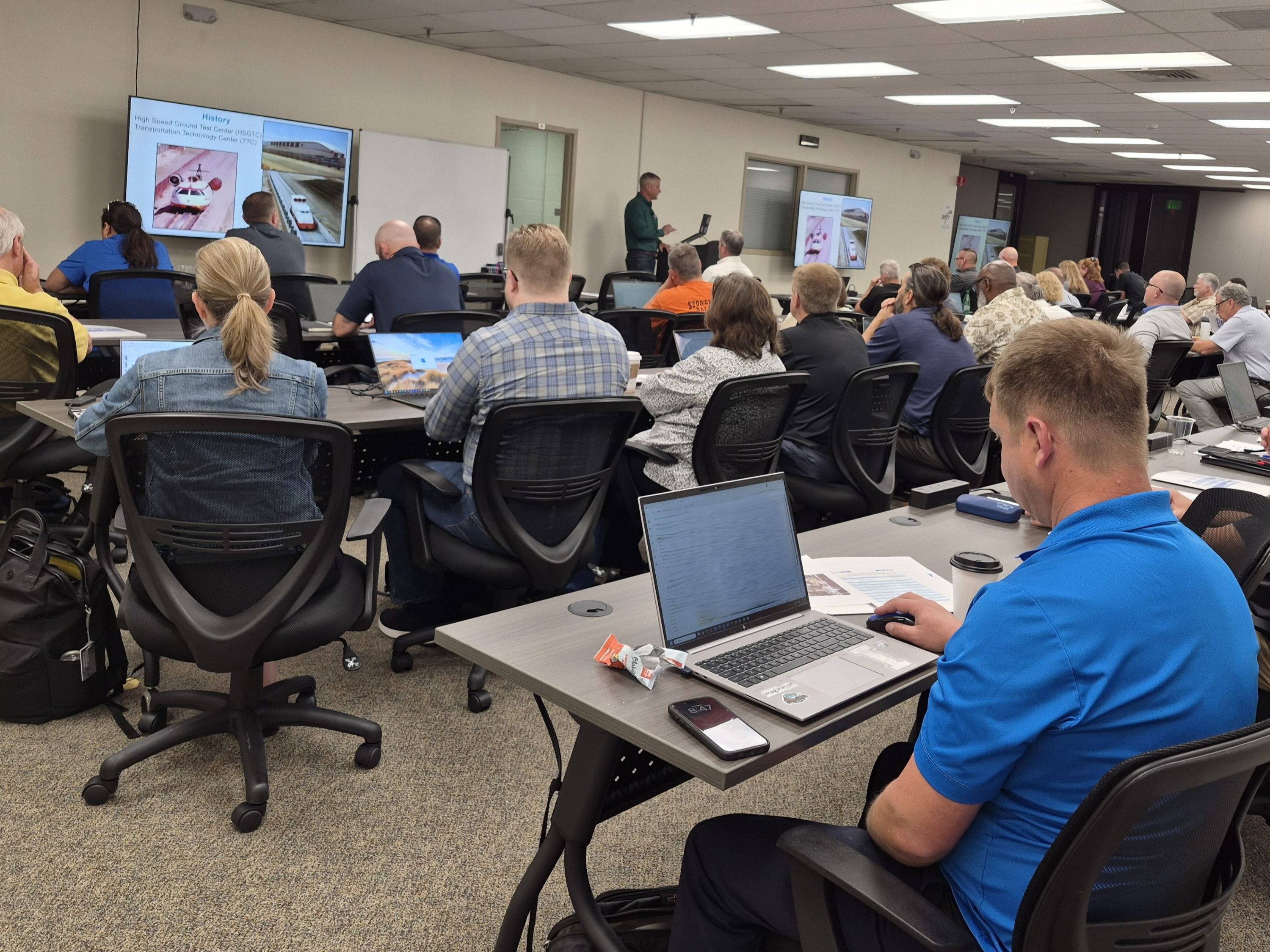
Last week, JR Gelnar, Fred Oelsner, Mike Ogborn, Jo Strang, Sabrina Waiss, and Sarah Yurasko attended the Joint Committee Meeting in Pueblo, Colorado. ASLRRA member ENSCO hosted the meeting, which included presentations by individual committees and tours of the Transportation Technology Center (TTC).
ASLRRA’s committee members are grateful to ENSCO for hosting the meeting. ENSCO provided meeting space and meals and planned the TTC tours.

ASLRRA maintains an industry calendar featuring events that may be of interest to members. If you have an industry event you would like included on the calendar and possibly in Views & News, please send relevant event details and links to Mariel Takamura for consideration.
Views & News is published by American Short Line and Regional Railroad Association.
Please contact Mariel Takamura, associate editor, with questions or comments.


