

Storied caboose returns to Durango & Silverton Narrow Gauge Railroad
Monmouth alum shows how a short line railroad built big impact
OmniTRAX purchases Ouachita Railroad and Camden & Southern Railroad
Burlington Junction lands agreement to serve Iowa industrial park
Railroad members! If you want to be featured in this section, please email us the link. You can also tag us (@ASLRRA) in your social media posts. Interested in seeing your railroad showcased in your local newspaper? Contact Amy Krouse for assistance.
The Federal Railroad Administration (FRA) has issued the notice of funding opportunity (NOFO) for the Consolidated Rail Infrastructure and Safety Improvements (CRISI) grant program. Over $2 billion in funding will be awarded, with applications due June 22.
ASLRRA urges members to work quickly to prepare documents, register in the System for Award Management (SAM) and grants.gov and secure letters of support. ASLRRA maintains a CRISI resources website with helpful information and links. There is also additional information for ASLRRA members when they log in to the site. In addition, the Association’s Member Discount Program includes grant writing Preferred Provider Colliers.
The CRISI program is significant because short lines are directly eligible for grant funding. These grants have been transformational for ASLRRA member short lines and thousands of rail shippers and have had a significant positive effect for hundreds of railroad suppliers. Short line projects have traditionally done well in the CRISI application pool.
Overall, this NOFO is streamlined and significantly shorter than those issued in past funding cycles. Organizations should note some changes to the application. For example:
Potential projects the FRA highlighted as noteworthy include those that:
View the FRA’s CRISI website here, which features links to a variety of program resources.
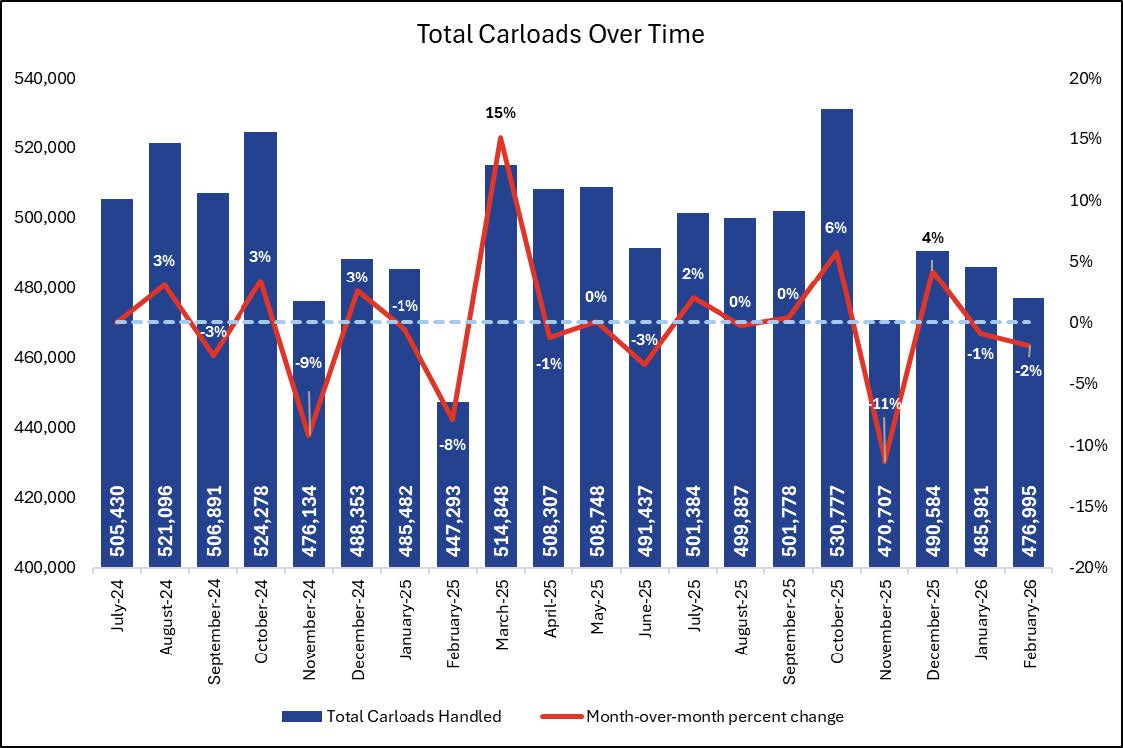
ASLRRA has published the latest Short Line Carloads Report with data from February 2026. While total carloads were down slightly from January, volume was significantly higher compared to February 2025.
Carloads increased year over year (YOY) for originating and terminating movements, as well as total handled. Only bridged movements were down in February 2026 compared to February 2025, though that decrease was in line with previous contractions.
Commodities that grew the most YOY were agriculture, coal and waste, while the largest decreases were in lumber, paper and wood products and durable manufactured goods. The report features tables comparing all major commodity groups by trip type, percentage of total carloads handled, total cars handled and more.
Carload data is based on a custom short line carload report created in cooperation between ASLRRA and Railinc based on waybill data submitted by railroads. This work product may not be disseminated without permission granted by ASLRRA. Contact ASLRRA at foelsner@aslrra.org for all inquiries.

ASLRRA has updated the Part 215, Railroad Freight Car Safety Standards CFR Training PowerPoint and Standards Exam resources. These are located under Part 243, Training, Qualification and Oversight for Safety-Related Railroad Employees in the Compliance Templates section of the Association’s website.
Railroads using the Part 215 template should download these updated materials. Those with questions should contact ASLRRA’s JR Gelnar.
ASLRRA railroad members can access the Association’s entire library of compliance templates for certain regulations under 49 CFR. This includes roadway worker protection, control of alcohol and drug use, accident and incident reporting, engineer and conductor certification and more. Associate business members also have access to certain templates. Log in to view all the available resources.
The Occupational Safety and Health Administration (OSHA) has updated its National Emphasis Program related to heat-related hazards.
Updates to the National Emphasis Program – Outdoor and Indoor Heat-Related Hazards are based on data from OSHA and the Bureau of Labor Statistics (BLS) over calendar years 2022-2025. This revised program is effective for five years starting April 10.
According to OSHA, the program “direct[s] agency resources where they can make the biggest impact – focusing inspections and outreach in industries and workplaces where heat stress risks are most likely to occur.” The revised program updates its target industries based on OSHA and BLS data. Included on the list of target industries is “Support Activities for Rail Transportation.”
Other changes to the program include removing outdated information, updating links, reorganizing and adding appendices and more.
Two new technical reports from the Federal Railroad Administration (FRA) discuss railroad automation design and improving rail safety through understanding ballast.
User-Centered Design for Railroad Automation: Phase I
This report discusses the first part of a two-part research project aimed at developing and demonstrating an improved interface between human operators and advanced automation in rail systems. Phase I examined issues related to human-machine interface and introduces a new concept called the Automation Awareness Assistant (A3). A3 is meant to improve a rail operator’s awareness of rail functionality and make suggestions for courses of action in the event of system failure, especially under conditions of high operator workload.
Phase II of the project will focus on developing, testing and refining an A3 prototype. For this project A3 will be designed for locomotive cabs, but researchers believe the A3 user interface concept can be applied to other rail and transportation systems.
Rail Safety Improvement through Enhanced Understanding of Ballast and Subgrade Interactions
In this study, a team from Pennsylvania State University examined how refining tamping practices can have an effect on operational efficiency and safety. Researchers conducted field tests on clean and fouled ballast conditions, using SmartRock sensors to capture data on ballast movement during tamping operations.
Research results showed that adjusting tamping parameters based on ballast conditions can improve tamping efficiency. Optimizing tamping operations using a data-driven approach not only enhances track stability and longevity but improves the safety and reliability of rail operations.
The Surface Transportation Board (STB) has issued an advance notice of proposed rulemaking, saying it is considering changes to its ex parte regulations. Comments on the changes being considered are due May 29.
Ex parte communication takes place between an organization involved in a proceeding and a non-party. The discussion must center on the merits or substantive outcome of a pending proceeding and take place without notice to all parties and without an opportunity for all parties to be present.
Though ex parte communication with STB members and staff is generally prohibited, there are some exceptions. In 2025 the Association of American Railroads (AAR) filed a petition for rulemaking to revise and streamline rules governing ex parte communications. This current effort by the STB to consider changes to ex parte rules stems in part from this petition.
ASLRRA is currently evaluating the rule for its effect on short lines.
The Virginia Department of Rail and Public Transportation (DRPT) released a draft of its Fiscal Year (FY) 2027-2032 Six-Year Improvement Plan (SYIP). The plan describes strategies for investments in public transportation and freight and passenger rail over the next six fiscal years.
The public can now review the draft plan here. Virginia’s Commonwealth Transportation Board (CTB) is seeking public feedback on transportation planning statewide, including on the DRPT’s plan. The CTB will hold public meetings to collect feedback, and individuals can share thoughts on DRPT’s SYIP at those meetings.
The DRPT will hold its own virtual public hearing on May 27 specifically to discuss the SYIP. Individuals who would like to participate must register in advance.
Michael Graham has been designated vice chairman of the National Transportation Safety Board (NTSB). Graham is currently an NTSB member.
Graham’s tenure as vice chair will last three years. He joined the NTSB in 2020, coming from a role as director of flight operations safety, security and standardization at Textron Aviation.

Thirty-seven members of the Senate have signed a letter to leaders of the Appropriations Committee’s Transportation, Housing and Urban Development Subcommittee requesting full funding for the Consolidated Rail Infrastructure and Safety Improvements (CRISI) program in the fiscal year 2027 Transportation, Housing and Urban Development, and Related Agencies appropriations bill.
The letter to Subcommittee Cindy Hyde-Smith (R-Miss.) and Ranking Member Kristen Gillibrand (D-N.Y.) describes the benefits of the CRISI program, which has been a valuable resource for small railroads and the businesses and communities they serve. CRISI grants have generated $5.2 billion in infrastructure investment across 48 states, further improving the safety and reliability of freight rail service nationwide.
A similar letter signed by 130 representatives was sent two weeks ago to leaders of the House Appropriations Committee THUD Subcommittee. That letter also urged full funding for the CRISI program.
Yesterday, U.S. Senators Chris Coons (D-Del.) and Josh Hawley (R-Mo.) introduced the Railroad Retirement Fairness Act. The bill would eliminate a federal law reducing railroad retirement payments for certain retirees and spouses who work in non-railroad jobs after retirement. Representatives Chris Deluzio (D-Pa.) and Troy Nehls (R-Texas) are leading a companion bill in the House.
The Railroad Retirement Board (RRB) discussed post-retirement work in the January 2026 edition of its monthly Q&A news release. According to the RRB, "Retired employees and spouses, regardless of age, who work for their last pre-retirement nonrailroad employer are subject to an earnings deduction of $1 for every $2 in earnings up to a maximum reduction of 50 percent of their tier II annuity component (and railroad retirement supplemental annuity, if applicable)."
The Railroad Retirement Fairness Act would eliminate the last prior employer deduction, allow railroad retirees and their spouses to continue non-railroad work without losing railroad benefits and ensure more equal treatment for all retirees.
The House and Senate are in session this week. Lawmakers will work on reopening the Department of Homeland Security (DHS). The Trump administration is pushing for Congress to pass funding for DHS by the end of April.
The Senate is also looking to take initial steps toward a second reconciliation bill for funding for Immigration and Customs Enforcement and Border Patrol. In addition, the House and Senate have begun their annual process of reviewing the President's budget request for fiscal year 2027 and formulating their own appropriations legislation.


The Mokena Illinois Railroad Company (MIRR), a quarter-mile short line established in 1994, anchors Ozinga Bros., Inc.’s primary Illinois ready-mix hub while supporting a consistent flow of inbound aggregates for more than three decades. Positioned for growth, MIRR is served by Iowa Interstate Railroad and strategically located along the I-80 corridor—minutes from four major interstate interchanges—offering over 20 acres of prime, rail-served land for transloading, storage, and future industrial development. Primary contact and Executive Vice President of Rail, James Kornas, Jr. can be reached by phone or email at the following: (708) 326-3671, jameskornas@ozinga.com.

MERMEC delivers flexible, state-of-the-art measurement solutions for track and rolling stock that enhance safety, reduce costs, and increase asset availability. Their diverse portfolio ranges from Turn-Key Railroad Inspection Vehicles as selected by BART to cost-efficient "Measurement as a Service" projects. These tailor-made solutions provide railroads with the accurate data and "Knowledge on Demand" necessary to optimize both infrastructure and transport operations. Thank you to Zach Stillwell of R.J. Corman Railroad Group for the recommendation.

What are the latest ways Association members can engage with ASLRRA? What is ASLRRA’s most recent call-to-action? Below are some of the different types of information the Association would love to gather.
Though the 2026 Annual Conference is over, ASLRRA continues to be grateful to all those who helped make the event a success.
Over 1,700 people explored the nearly sold-out Exhibit Hall, attended education sessions, listened to keynote speakers and award winners and participated in a variety of networking opportunities.
The Association has sent a final email to all attendees with important information, including a post-conference survey. Everyone is encouraged to submit a response, as survey data helps guide decision-making for next year’s gathering.
The email also includes links to event photos, headshots and a final attendee list. Those who did not receive an email are encouraged to check their spam or junk folders, or reach out to ASLRRA if those efforts prove fruitless.
ASLRRA has also posted videos from the General Session, namely award videos and recordings of speeches made by the Hall of Fame honorees, Distinguished Service Award winner and Safety Person and Safety Professional of the Year. Find these videos on ASLRRA’s YouTube channel or on the Association’s award webpages.
Though several exciting events remain in 2026, including the first-ever Fall Super Regional Meeting held Oct. 5-7, ASLRRA encourages everyone to save the date for the 2027 Annual Conference. It takes place March 14-16 in New Orleans, Louisiana.
As ASLRRA’s Doug Golden Scholarship program continues to grow in popularity, the Association encourages eligible small railroad employees to consider taking advantage of this member benefit before 2026 funding runs out. Click here to learn more about the scholarship and submit an application.
Doug Golden Scholarships offer up to $1,200 to help cover costs associated with registration fees, travel and lodging for industry-specific training to improve railroad safety and compliance practices and enhance overall operations. Appropriate training topics include track, bridge, and signal inspection and maintenance, locomotive and freight car inspection and maintenance, regulatory and compliance training and railroad safety and operations training.
Employees of ASLRRA-member small railroads earning less than $10 million in annual revenue are eligible. Scholarships are capped at one per person and two per railroad. Applications are submitted via online form and are evaluated as they are received, with scholarships awarded on a rolling basis.
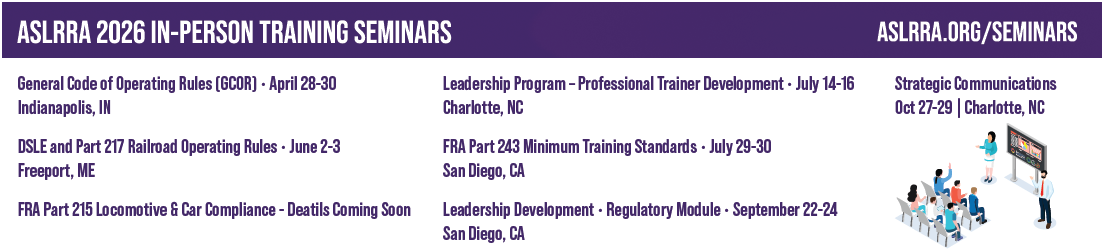
Scholarships can be applied to nearly all of the in-person training seminars offered by ASLRRA. View a list of training seminars with confirmed dates and locations below.
Click here to see additional upcoming seminars as well as event details and online registration and hotel booking links.
Würth is ASLRRA’s Preferred Provider of personal protective equipment (PPE) and related services and their customer-first approach to service and support has a long history. Since opening their doors, Würth has helped thousands of companies protect their employees and work with optimum efficiency for maximum output. Their team of railroad specialists currently supports nearly 200 short line railroads, rail industry contractors and Class I railroad companies.
ASLRRA members can depend on Würth for quality safety and industrial products and exceptional customer service, plus discounted pricing on a huge assortment of products and equipment needed to implement an effective and efficient safety program. Offerings include foot and leg protection, signs, ergonomic products, hearing and eye protection, clothing protection, lighting and electrical products, storage containment and environmental spill cleanup, traffic control and much more.
Visit the Association’s Member Discount Program page to view Würth’s complete product offering and suite of services and start saving today.

The New Jersey Department of Transportation announced it will award over $26 million to 11 freight rail projects through the Rail Freight Assistance Program, made possible by the State Transportation Trust Fund.
Four ASLRRA members will receive grant funding: Winchester & Western Railroad, New York Susquehanna & Western Railway, Morristown & Erie Railway and Conrail. These railroads will make track and surface upgrades, improve bridges and expand rail capacity.
In addition to other railroads receiving grants, funding went to ports, private organizations and local governments. These projects will also focus on infrastructure improvements to bridges, rail facilities, track, crossings and more. View the full list of awardees here.
The Public Utilities Commission of Ohio (PUCO) has approved funding for safety upgrades to a rail crossing in the city of Toledo.
ASLRRA member Ann Arbor Railroad will install gates and flashing lights at the crossing. The railroad will receive $415,600 in federal funds to pay for the upgrade.


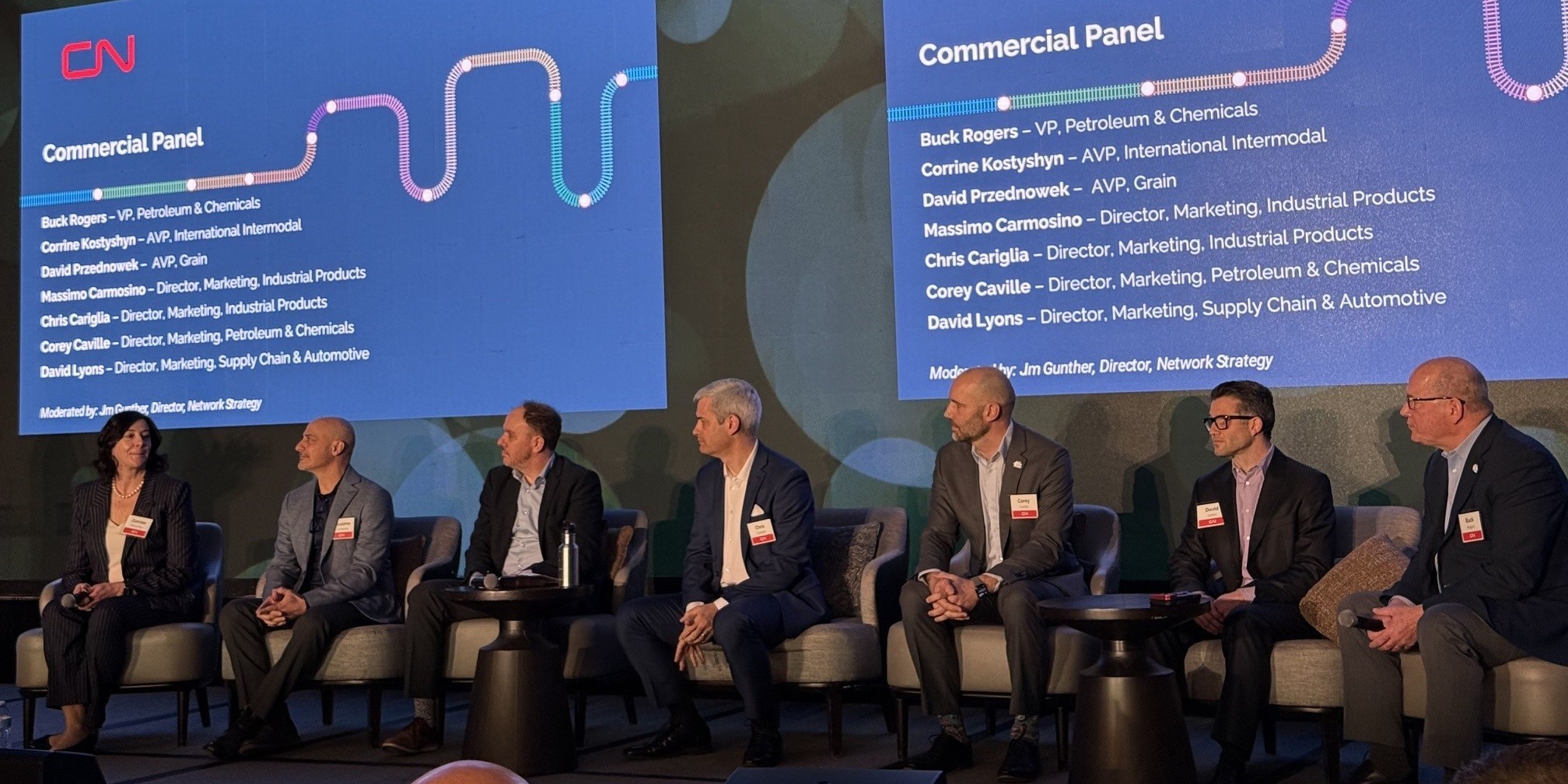
Earlier this week, Chuck Baker traveled to Chicago, Illinois to attend the CN Short Line Conference (pictured below). The event included a general session with an economic update and presentations on government affairs and commercial engagement, as well as an opportunity for individual commercial meetings with CN representatives.
And today, Baker spoke at the Coalition for America’s Gateways & Trade Corridors (CAGTC) Annual Meeting and Anniversary Celebration in Washington, D.C. He participated in a panel discussion titled “Growing the Federal Focus on Freight.” The event also included keynote speaker Congressman David Rouzer (R-N.C.).

Experts in various rail industry legal issues have presented several webinars. Recordings of those webinars are available at any time to ASLRRA members. Look for the following titles in the Association’s On-Demand Webinar Library:
There are over 200 webinar recordings available in the Association’s library. Visit ASLRRA’s webinar homepage and log in to view these and other on-demand offerings.

ASLRRA maintains an industry calendar featuring events that may be of interest to members. If you have an industry event you would like included on the calendar and possibly in Views & News, please send relevant event details and links to Mariel Takamura for consideration.
Progressive Railroading magazine recently featured the Short Line Safety Institute (SLSI) in an article focused on the organization’s Safety Train project. The article also discussed the connections between SLSI and Federal Railroad Administrator David Fink, who when he was head of Pan Am Railways was one of the first to take advantage of SLSI’s Safety Culture Assessment (SCA) program.
For its Safety Train project, SLSI is working to build a train that can travel across the U.S. to bring life-size, hands-on hazardous materials (hazmat) training to short line railroaders and emergency responders. The train will comprise a tank car, a boxcar converted to a classroom and a flat car training platform with valves and fittings.
The Safety Train is SLSI’s latest effort to bring critical hazmat training to underserved communities across the country. Since its start over a decade ago, SLSI has been dedicated to offering a variety of tools, resources and in-person training to the rail industry and, more recently, emergency responders. The organization continues to expand its training opportunities, but at its core is the safety culture work with which Fink is so familiar.
The article goes on to describe Fink’s connection to SLSI. When ASLRRA first proposed the idea of SLSI, Fink’s Pan Am Railways was an Association member. Soon after SLSI began, Pan Am Railways was one of the first railroads to undergo a voluntary SCA. Then it asked the team back to conduct a second assessment.
Fink’s familiarity with SLSI helps him understand the organization’s vision. The Safety Train and all of SLSI’s offerings play an invaluable role in helping small railroads make their operations safer, an effort Fink wholeheartedly supports.
Railway Age magazine has announced this year’s Readers’ Most Influential Leaders. Among the 15 winners are five from ASLRRA-member companies.
Winners are determined by the public via an online poll. Every person must be an active, non-retired individual in the North American freight, switching/terminal and passenger railroad; rail transit; government agency; and supplier communities. Those chosen for this award “embody an entrepreneurial spirit anchored in a commitment to service, safety and sustainability.”
Railway Age will include profiles of each winner in its May issue. ASLRRA congratulates all of this year’s honorees, especially
Railway Track & Structures (RT&S) magazine has announced the winners of its 2026 Engineers Under 40 award. Thirteen individuals, including three ASLRRA-member employees, were honored for their accomplishments in their fields.
The Association congratulates all this year’s winners, especially
On May 13, ASLRRA supplier member ZTR will hold a webinar discussing ways to get the most out of aging fleets without investing in full system replacements or new locomotives.
Presenters will discuss a variety of available technologies to extend locomotive life, reduce downtime and maintenance costs and improve fleet readiness. This webinar is geared toward short line railroads focused on maximizing operations on tight budgets and limited resources.
Click here to learn more about the webinar and to register.
Views & News is published by American Short Line and Regional Railroad Association.
Please contact Mariel Takamura, associate editor, with questions or comments.


