
G&W's Pawlanta: Flexibility is Key to Success in Rail
Mississippi Export Railroad Hosts Economic Development Trip
Alaska Railroad Promotes Real Estate Director
RJ Corman Supports Railcar Recovery Post WV Flood
OmniTrax Launches Connect Transload Platform
Railroad members! If you want to be featured in this section, please email us the link. You can also tag us (@ASLRRA) in your social media posts. Interested in seeing your railroad showcased in your local newspaper? Contact Amy Krouse for assistance.
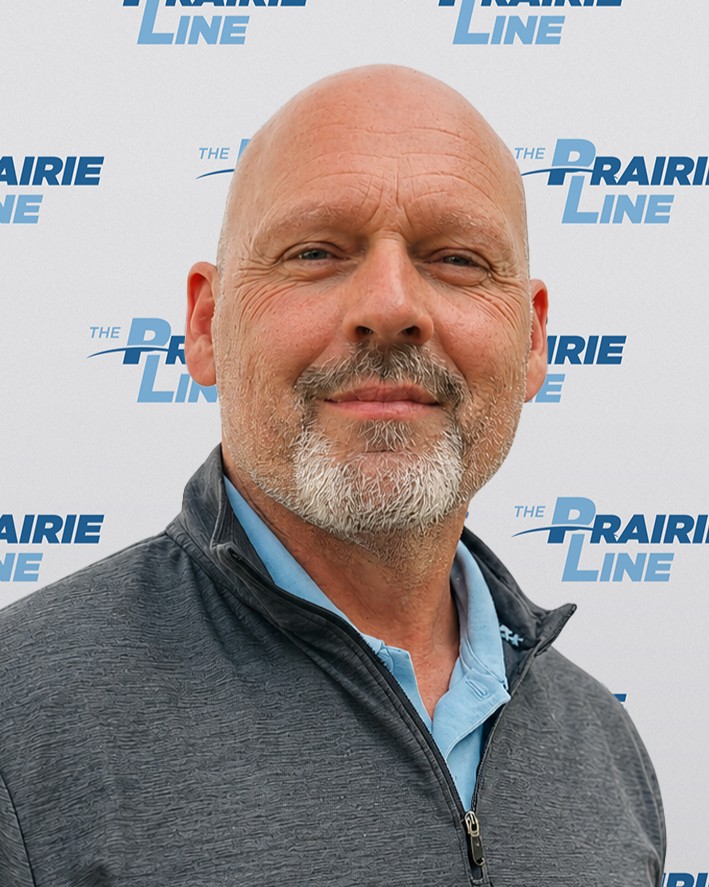 By Todd Furlow, Vice President of Operations, The Prairie Line (Special to Views & News)
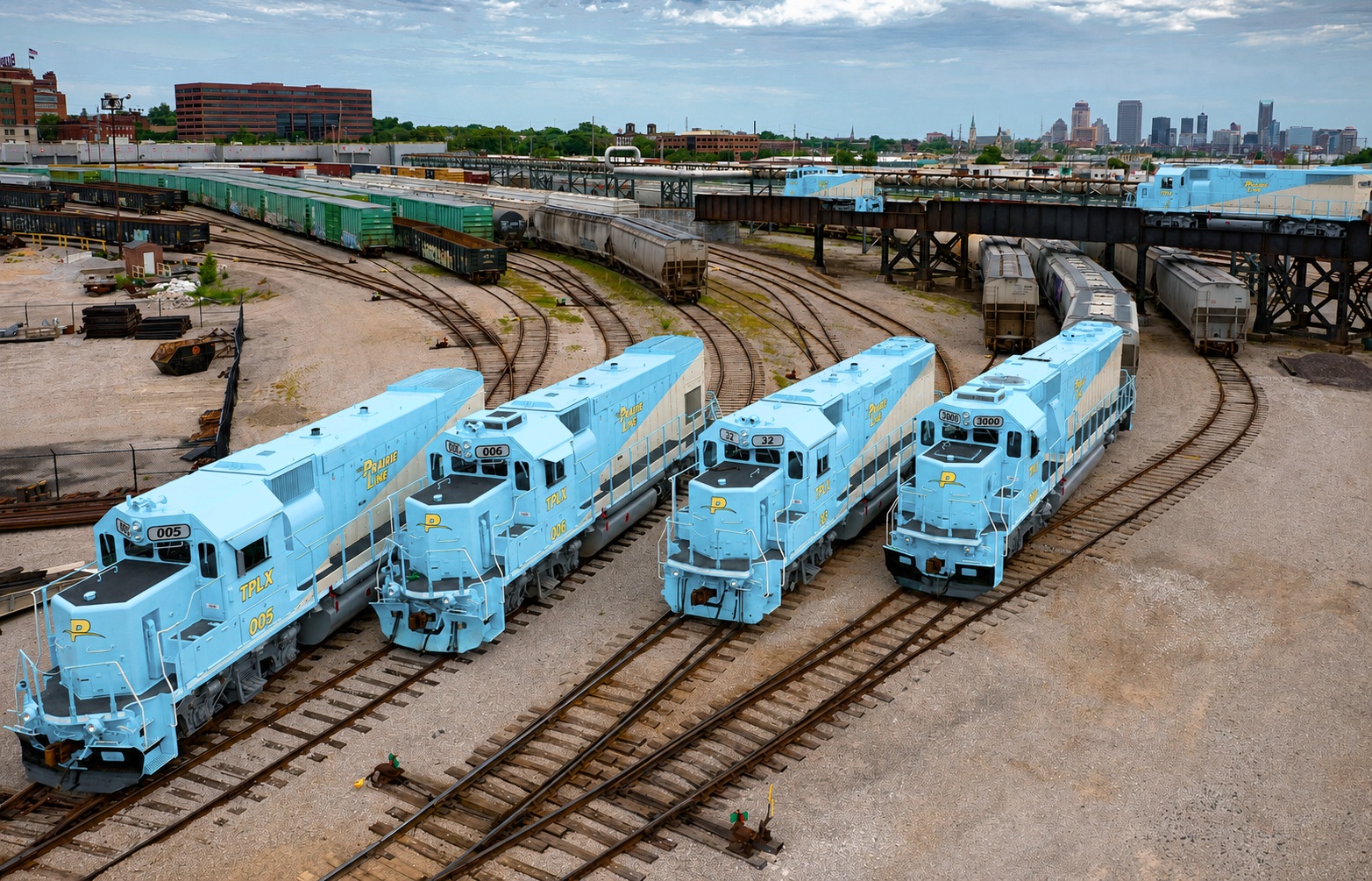
In 2017, The Prairie Line took on its very first customer with a greenfield operation we built from scratch, from the track to the crews to the processes. Today we move more than 300,000 carloads a year across eight states, with 200 employees and 50 locomotives, and interchange with every Class I railroad. Nearly everything we learned along the way comes down to one question: What do customers really want from a rail service partner?
The short answer is that they never want to wonder whether the switch will happen, whether the outbound will make its train, or whether anyone is paying attention. Here is how we try to earn that.
It starts with listening. Good service begins with communication. Find out the customer's pain points and what is driving them. Be a good listener, then be flexible enough to adapt and modify your operation to meet those needs. Consistency comes from continued on-time service, and you have to be relentless about execution.
Be embedded, not at arm's length. Our managers meet with each shift's supervisor twice a day and plan every loadout at the start of the shift, because we would rather find problems before they find the customer. From the customer's chair, that makes us the partner who plans their day with them.
The best customers make you better, too. One of our largest customers includes us on their weekly production and operations calls, along with a monthly touch point where we cover the good, the bad, and the ugly. Our mid-level and senior managers follow up with quarterly on-site visits. Partnership runs in both directions, and we are better railroaders for it.
Communicate hardest when things go wrong. Communication has to be timely, honest, and open. Both sides hold each other accountable and leave pride out of it. We communicate well in advance of outages and disruptions, and when a customer gives us the time to adjust, we deliver. That has been the track record: nearly ten years without a missed switch, an operating standard we hold ourselves to every day.
Sometimes the need goes beyond the day's plan. If it means holding a crew over for a late switch, we do it. If it means bringing in another crew, we do it. The service is built around the customer's schedule, not ours.
People are what make all of this work. We hire for character and train for skill. Humility, work ethic, and attitude are the criteria, and they are why service holds steady over years instead of churning with turnover. At one of our grain customers, the operators keep a picture of our most senior conductor in their control room. That says a lot about what these relationships can become.
And all of this matters because bad rail service rarely shows up as one big failure. It hides in slow turns, demurrage, storage charges, and plant staff pulled off their own jobs to babysit the operation. The most expensive rail service is the one that looks cheap. Done right, the value is real: one customer identified and acknowledged more than $14 million in savings over four years.
Our mission is to provide service that far exceeds the customer's expectations, with a team that works hard, supports each other, and above all is safe. If I could give one piece of advice to the railroads and rail customers reading this, it would be the same advice on both sides: be honest with each other, be willing to hear the good and the bad, and be flexible. From the railroad's side, be fanatical about customer service. From the customer's side, treat your rail partner like a true partner. Do that, and the growth takes care of itself.
About The Prairie Line
The Prairie Line is a privately held, third-party rail switching and logistics company headquartered in St. Louis, serving industrial customers across eight states. Founded in 2017, the company provides in-plant rail switching, track maintenance, rail storage, railcar repair and mechanical services, locomotive leasing, and logistics support, backed by FRA-certified crews and a safety-first culture built into every switch. Learn more at www.theprairieline.com.
In this special article, Todd Furlow, vice president of operations at ASLRRA member The Prairie Line, offers his advice for growth through an emphasis on robust customer service.

The Federal Railroad Administration’s (FRA) Fatality Analysis of Maintenance-of-Way Employees and Signalmen (FAMES) Committee has published its Fourth Quarter Safety Alert.
The committee publishes the alert to remind roadway workers of the spike in fatal roadway worker incidents in the fourth quarter of the year. Comparison of data from 1997-2025 shows 36% of all fatalities occurred in the fourth quarter. Of the fourth quarter fatalities, 47% occurred in October.
Although the FAMES Committee has not identified the reason for this spike in fatalities, the safety alert reminds workers to be hyper-vigilant in the application of on-track safety procedures, especially during this time period. Workers are reminded to speak up if someone is seen fouling the track without on-track safety protection. The committee also reminds individuals that if there are concerns about the application of on-track safety, they have a legally protected right to make a good faith challenge and stay clear of track until the challenge is resolved.
The U.S. Food and Drug Administration (FDA) published a final order exempting certain class II clinical toxicology test systems from premarket notification requirements, known as 510(k).
Drug test systems are considered class II, and while some class II tests were eligible for FDA exemption from 510(k) requirements, those meant for federal drug testing programs, such as those run by the U.S. Department of Transportation (USDOT), were not exempt. This new order extends that exemption to all tests intended solely for employment and insurance testing, including federal programs.
According to the National Drug and Alcohol Screening Association (NDASA), the order helps remove a major barrier to the adoption of oral fluid drug testing. Although the USDOT had authorized oral fluid as an alternative drug testing methodology, it could not proceed before at least two laboratories were approved for the procedure. Having to meet the FDA’s 510(k) requirement was preventing laboratories from pursuing that certification process.
Under Federal Railroad Administration (FRA) regulations, certain safety-sensitive railroad employees are subject to drug and alcohol testing. ASLRRA Senior Vice President, Safety, Regulatory and Environmental Policy Jo Strang says the possibility of having oral fluid testing is a positive development, as it is much less invasive than current urine testing procedures.

Know a company that would benefit from joining and participating in ASLRRA? Please contact Vice President, Membership Danialle Lovik via email or at (202) 585-3443.

Evolved Benefits is an employee benefits and ACA compliance firm specializing in affordable healthcare solutions for employers with part-time, variable-hour, and hourly workforces. They provide MEC and Minimum Value health plans, ACA compliance support, and customized benefit strategies. Evolved Benefits’ plans are administered through the TPA, SBMA, and they work closely with employers, associations, brokers, and payroll partners to provide practical, cost-effective benefit solutions. For inquiries, please contact Aaron Lopez, Director of National Sales, by phone at (619) 389-7584 or by email at aaron@evolvedbenefits.com. Special thanks to Coastal Payroll for the recommendation.


Aon is the world’s leading enterprise solution for the most accurate and fair workforce assessments at scale, powered by deep science, workforce data, and industry knowledge. A pioneer in the industry, Aon designs and implements assessments for pre-hire and post-hire purposes. Aon has direct experience developing value-adding assessments for railroad-specific frontline roles and job clusters.
Click here to learn more about ASLRRA’s Member Discount Program and view all available products and services, or contact ASLRRA’s Sabrina Waiss for more information about becoming a Preferred Provider.
Check out the following important sessions addressing FRA Part 219 Control of Alcohol and Drug Use, and covering regulatory requirements, testing programs and issues, and educational materials for railroads:
ASLRRA’s On-Demand Webinar Library offers more than 200 recordings on a variety of topics. Click here to log in and access the library.
Registration is FREE for ASLRRA members!
Only 3 spots remain!
ASLRRA Leadership Program: Crisis Communications Training Seminar
October 27-29, Charlotte, North Carolina
This new training seminar will help railroads prepare for their worst day by developing a communications strategy and working with key partners in advance of an incident. During the seminar, individuals or teams from a railroad will create a Crisis Communications Plan and become proficient in using a Communicators Response Guide to determine the appropriate level of response based on the incident. Training will also address the role of the railroad communicator when Incident Command is in place. Attendees will return to their railroad with a communications plan that they may further refine, implement and incorporate into their railroad’s Emergency Response Plan.
Developed as a new module of ASLRRA’s Leadership Program, the crisis communications training seminar is geared to company leaders who are responsible for driving the external response to an incident on their railroad, as well as company spokespersons and communications professionals.
ASLRRA’s On-Demand Webinar Library offers more than 200 recordings on a variety of topics. Click here to log in and access the library.

Congratulations to the following individuals who were elected at the recent ASLRRA Fall Super Regional Meeting during regional Sand House sessions.
Central Region Vice President - Danny Robbins, President, North Louisiana & Arkansas Railroad
Pacific Region Vice President - Ross Lane, Assistant Vice President, Government Affairs, San Joaquin Valley Railroad / Genesee & Wyoming
Southern Region Vice President - Kate Bourgeois, President & CEO, Mississippi Export Rail Company
Regional Director, Eastern Region - Charles Hunter, Asst. Vice President, Government Affairs, New England Central Railroad Inc./ Genesee & Wyoming
Regional Director, Pacific Region - Robert Pinoli, President & CEO, Mendocino Railway
Regional Director, Southern Region - Curtis Sloan, VP, Policy & Sustainability, Alabama Southern Railroad / Watco
At the Board Meeting on October 8, ASLRRA Chairman Justin Broyles welcomed the new members, and recognized the contributions of Otis Cliatt II, President, Pacific Harbor Line, Ben Tarbutton, President, Sandersville Railroad Company, Cathrin Banks, President & General Counsel, Chesapeake and Delaware LLC and Jason Bradt, VP of Operations, Coastal Division, G & W Railroad Services, Inc. for their years of service to the association.
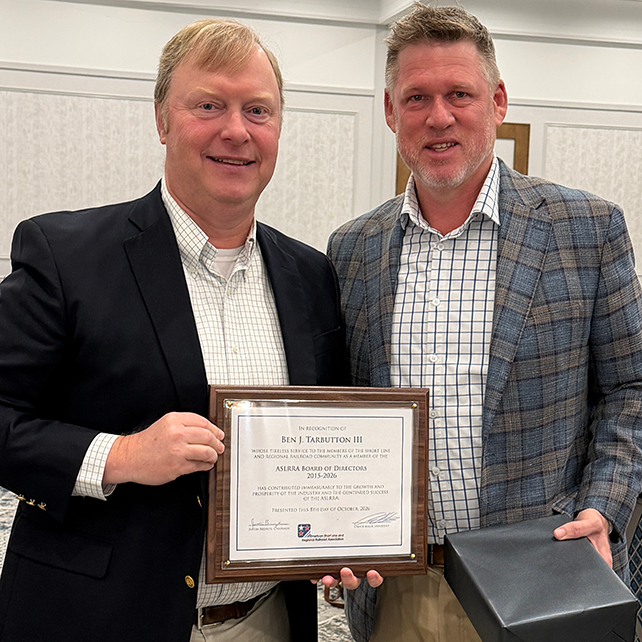
Ben Tarbutton, President, Sandersville Railroad is thanked for his years of Board Service by Justin Broyles, ASLRRA Chairman

In the October issue of Railway Age magazine, Chuck Baker’s ASLRRA Perspective column focuses on the importance of advocacy efforts and the ways ASLRRA is speaking out on behalf of its members’ interests.
Baker outlines the many fronts on which ASLRRA is active. The Association is working with members to draft comments for the Surface Transportation Board (STB) to consider in its review of the Union Pacific/Norfolk Southern merger application.
On the regulatory front, ASLRRA has weighed in on efforts by the Federal Railroad Administration (FRA) to update outdated regulations. The FRA completed 10 rulemakings in August, six of which ASLRRA had submitted comments on.
“The FRA is committed to this accelerated regulatory reform process, said Baker, “And it is incumbent on short lines to continue to engage with the FRA before and during the comment periods so rulemaking outcomes work for small business railroads.”
Baker also discussed ASLRRA’s advocacy work on the legislative front, with an emphasis on key issues like the 45G short line infrastructure tax credit, funding for the Consolidated Rail Infrastructure and Safety Improvements (CRISI) grant program, truck size and weight and the Railway Safety Act.
Though engagment can be difficult for small-business railroads concerned with day-to-day operations, it is the best way to get results. The short line industry has benefited from these efforts in multiple ways. ASLRRA urges industry professionals to join this advocacy, particularly through participation in Railroad Day on Capitol Hill. It will be held on May 19, 2027.

ASLRRA maintains an industry calendar featuring events that may be of interest to members. If you have an industry event you would like included on the calendar and possibly in Views & News, please send relevant event details and links to Mariel Takamura for consideration.
Rutgers University will hold its first Rail AI Academy training course on Nov. 17. This course is the first of a three-part program aimed at helping railroad professionals “use AI to improve safety, reliability, efficiency, and asset management at their respective agencies.”
The one-day course takes place in person at the Rutgers Center for Advanced Infrastructure and Transportation (CAIT) Building. It will cover the foundations of AI in rail and transit.
This program is intended for employees at freight railroads, passenger rail industries, state departments of transportation and public-sector transportation agencies. The cost is $200, and attendees can also receive three professional development hours. Click here to register.
Views & News is published by American Short Line and Regional Railroad Association.
Please contact Mariel Takamura, associate editor, with questions or comments.


