
North Shore Railroad’s Veterans Benefit Voyage raises $16,000
OmniTRAX names Strickland VP, state government affairs
Railroad members! If you want to be featured in this section, please email us the link. You can also tag us (@ASLRRA) in your social media posts. Interested in seeing your railroad showcased in your local newspaper? Contact Amy Krouse for assistance.
ASLRRA celebrates Veterans Day by highlighting the enduring connections between the U.S. Armed Forces and the railroad industry. For the second year, the Association shines a spotlight on short line railroaders who have served in the U.S. military, inviting them to share their insights and personal experiences in both arenas.
Contributors to this year’s story have an average of 15 years’ experience in the railroad industry and 13 years of military service. They have served in the Army, Navy, Marine Corps and Air Force and their military roles run the gamut. Some of their career fields include pilot, intelligence analyst, infantryman, combat engineer, logistics specialist, technical administrator, gas turbine systems technician, air freight flight chief, tactical vehicle operator and many more.
Their railroad roles are equally diverse, including carman, conductor, engineer, roadway worker in charge, safety officer, compliance manager, vice president, general manager and superintendent.
Yet despite sometimes significant differences in age, work responsibilities and years of experience, the contributors’ comments were often strikingly similar. These similarities support the idea that military service fosters certain traits, and those traits often directly influence an individual’s ability to survive and thrive in the freight rail industry.
Why are military veterans well suited for railroad work? RailPros’ Royce Dalton summed it up simply. It’s their “ability to adapt and overcome…being flexible and following rules and regulations.”
That sounds contradictory, but it makes perfect sense to veterans and to railroaders.
Military work, especially in the field, requires planning and discipline, but also quick thinking and the ability to pivot on a dime. There’s a need for teamwork and trust, knowing that each person can execute their tasks well, despite any challenges.
“Military training develops the ability to remain calm, assess conditions and respond effectively while maintaining focus on safety and mission objectives,” said Wabtec Corporation Senior Engineer Troy Chatwin.
Alaska Railroad Engineer Mathieu Gibert echoed that sentiment, saying, “Veterans understand the importance of getting the job done while recognizing that certain steps cannot be skipped along the way.”
Physical working conditions cannot be overlooked as a similarity when comparing industries. Many contributors described how their military jobs required work with heavy machinery, or took place outside in various weather conditions, or involved night shifts, odd hours and frequent travel. For many, those experiences further helped ease the transition to railroading.
Still, individual skills developed through work experience have played only a partial role in contributors’ successful career change. The desire to continue to be part of a close-knit team and serve an iconic and historic industry also endure.
“The reason I look forward to coming to work, whether it's 100 degrees in St. Louis or not, is that these guys care about me, they want to get the job done right, and I know my manager and the people above him are looking out for us,” said The Prairie Line Conductor Paul Flores. “The best part of working here is the family dynamic they're trying to create.”
“Veterans bring an appreciation for service and purpose. The railroad is bigger than any one occupation or department,” said Alaska Railroad Talent Acquisition and Development Manager Wink Hinkley. “Each person contributes to accomplishing a larger mission. Veterans understand that concept very well.”
Veteran Recruitment, Hiring and Retention According to Railroaders
In addition to sharing their thoughts about why military veterans make for strong railroaders, contributors had advice for veterans thinking about pursuing railroad work, as well as advice for railroads looking to hire veterans.
One general theme? Railroaders should not define themselves only by their resumes, records or job descriptions.
“Do not underestimate how transferable your military experience is,” said Anacostia Rail Holdings Company Chief Safety and Compliance Officer Herman Crosson. “You may not immediately understand railroad terminology or regulations, but you already possess many of the qualities the industry needs.”
Still, points out Ouachita Railroad General Manager Michael Robbins, veterans interviewing for a railroad job should be able to “focus on [their] military career from a personnel management and crisis action standpoint” and know “how to translate [their] military experience to what the company is looking for.”
When offering hiring advice directly to railroads, many contributors urged HR teams not to focus only on direct comparisons.
“Look beyond just matching military job titles to open positions and instead focus on the…potential veterans bring,” said Wabtec Corporation Lead Risk Analyst David John.
The Prairie Line Operations Manager Kevin Wulf and Vice President Mike Arnolds shared those thoughts.
“Recruit for the traits, not the resume,” said Arnolds.
Wulf said, “hire for character and train the rail skills.”
Getting veterans in the door is one thing, but keeping them on staff is another, as many pointed out.
“Retention is just as important as recruitment,” said John. “Providing mentorship, clear career paths, and opportunities for continuous learning can help veterans successfully transition and grow within the organization.”
Ultimately, the experiences shared by this year’s Veterans Day story contributors help explain why roughly 1 in 6 railroaders are military veterans. They also explain how and why short lines should work to hire and retain these individuals.
These stories tell of an enduring and fruitful connection between the military and the freight rail industry. The experiences are unique but the message has not changed: serving in the U.S. Armed Forces can help build a foundation for a successful career in railroading.
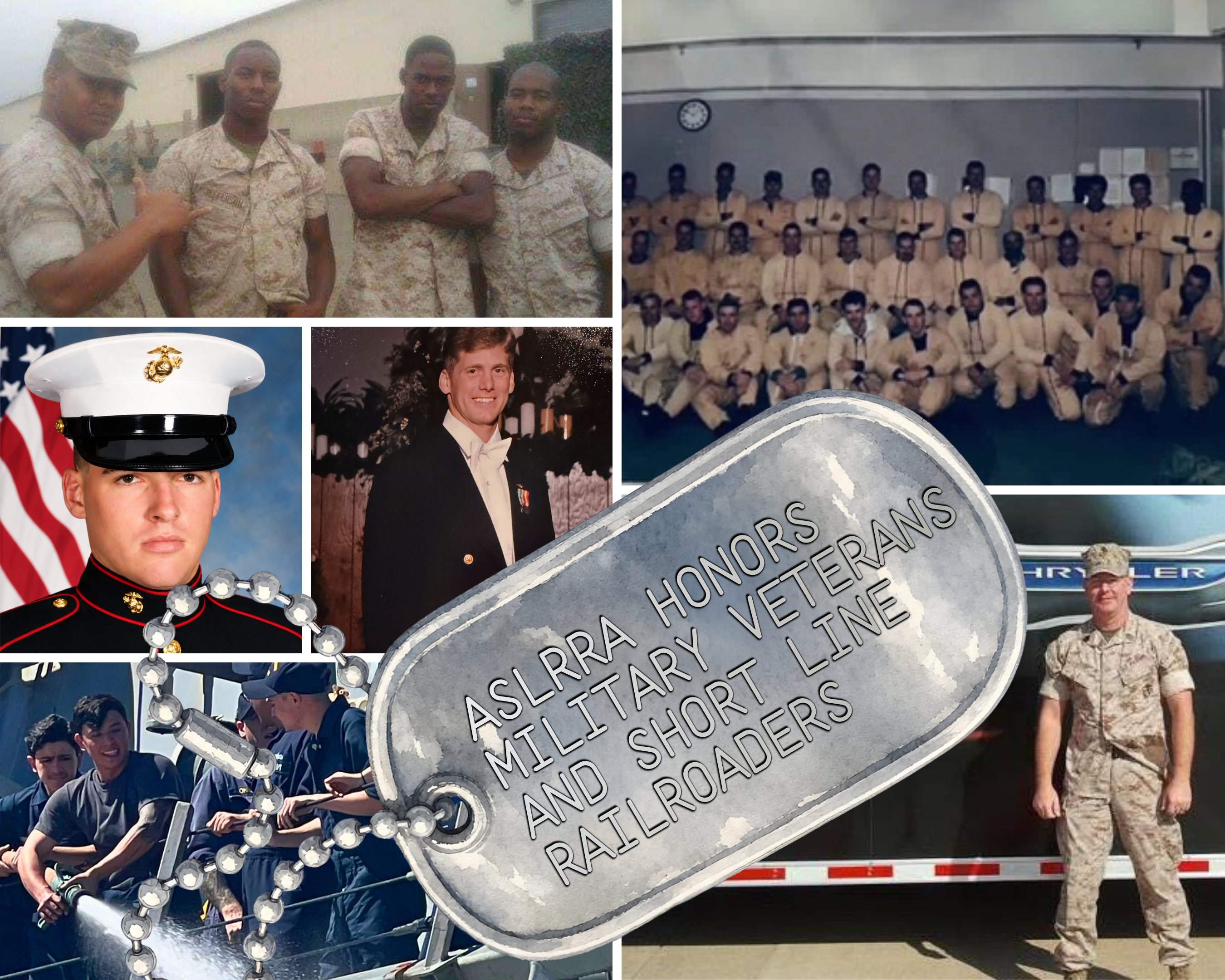
ASLRRA thanks all those who contributed their stories and photos for this article and the Association's Veterans Day social media campaign. It is truly our honor to share these experiences with a broader audience.

The Surface Transportation Board (STB) has issued a policy statement addressing the scope of its jurisdiction over certain rail transportation issues and preemption of conflicting laws. ASLRRA published a response to the STB’s statement, welcoming this clarification from the agency.
A copy of the full STB statement is here.
The statement explains the STB’s authority over rail transportation and the preemption of state and local laws under the ICC Termination Act of 1995 (ICCTA). The statement also explains how ICCTA preemption works, discusses common state and local preemption issues and describes how ICCTA is reconciled with other federal laws, such as the Clean Air Act and Clean Water Act.
By publishing this information, the STB hopes to “increase certainty and clarity, facilitate the efficient resolution of disputes, lower litigation and regulatory costs, and promote collaboration among railroads, shippers, communities, and government agencies.”
“ASLRRA and the nation’s 600+ small business short line freight railroads applaud the STB’s commonsense, practical guidance on preemption and the scope of its jurisdiction over rail transportation,” said ASLRRA President Chuck Baker. “We expect that this policy statement will serve as a concise, actionable reference for interested parties and the public. Explanations from the STB about its jurisdiction and the application of preemption under the ICCTA, and how the Board has analyzed frequently occurring questions, will reduce confusion and uncertainty and promote collaboration to achieve the national uniformity that Congress intended.”
In addition to issuing a statement, the STB created a website, Preemption Policy, that offers information on STB jurisdiction and specific preemption topics in a more accessible, user-friendly layout.
The statement and accompanying resource page came about in part as a response to a request for clearer guidance on preemption under ICCTA from ASLRRA and a coalition of railroad and shipper organizations. Last September, ASLRRA and five other groups, including the Association of American Railroads, sent a letter to the STB requesting it provide “essential and authoritative guidance” to stakeholders.
The Wisconsin Department of Transportation (WisDOT) is soliciting public feedback on its 2027 Wisconsin State Freight Plan. Comments are due Dec. 1.
The plan, which is updated every four years, discusses Wisconsin’s current and future freight needs across multiple modes of transportation. Included is a discussion of rail trends and challenges, system needs and planned policies for the state’s rail industry.
WisDOT is accepting feedback by mail, email or phone. Contact information can be found in WisDOT’s press release announcing the open comment period. Click here to view the draft plan.
The Michigan State Transportation Commission (STC) approved a final version of the Michigan Department of Transportation’s (MDOT) 2027-2031 Five-Year Transportation Program.
The document includes a list of all planned road and bridge projects and provides information about investments across all modes of transportation under MDOT’s authority. Appropriations for Michigan’s passenger and freight rail program, which includes ports, is estimated at $1.2 billion over the next five years. These investments will support freight rail preservation and enhancement, railroad crossing safety, economic development and other initiatives.

ASLRRA joined hundreds of national, state and local organizations in signing a letter of support for comprehensive permitting reform legislation found in the Bipartisan American Affordability and Jobs Act of 2026 (BAAJA).
On Monday, the Senate advanced the BAAJA in a 73-25 vote. This moves the bill closer to a final Senate vote.
The U.S. Chamber of Commerce coordinated the letter, which was addressed to all members of Congress. The letter says that passing the bill would help by “ensuring needed projects, investments, and other activities can move forward in a timely, predictable, and transparent manner.”
Senators Martin Heinrich (D-N.M.), Mike Lee (R-Utah), Shelley Moore Capito (R-W.Va.) and Sheldon Whitehouse (D-R.I.) introduced the BAAJA on Sept. 30. Some key points in the 417-page bill include procedural changes to the National Environmental Policy Act (NEPA) and changes to the National Historic Preservation Act.

Registration is open for ASLRRA’s 2027 Annual Conference & Exhibition, which will be held March 14-16 at the New Orleans Ernest N. Morial Convention Center in New Orleans, Louisiana. Click here to register now and secure the Early Bird Rate.
ASLRRA reminds everyone that the Association does not employ or partner with third parties to book rooms. Anyone who receives a solicitation from a hotel scammer should contact meetings@aslrra.org immediately.
The only authorized source for hotel reservation information for conference hotels is the Association’s website. Click here to book a room in one of the six hotels in which ASLRRA has a room block.


Loram offers discount pricing on its Aurora Track Inspection Technology providing comprehensive tie inspections generating detailed reports allowing railroads to streamline capital maintenance programs and ensure they are in line with industry regulations with compliance reports.
Click here to learn more about ASLRRA’s Member Discount Program and view all available products and services, or contact ASLRRA’s Sabrina Waiss for more information about becoming a Preferred Provider.
Nov. 12, 2026: Using Rail Protect to Support FRA 172.820 HazMat Route Risk Analysis
Representatives from ASLRRA supplier member Tiez Technologies will discuss Rail Protect, an application built to support FRA 172.820 hazmat route risk analysis. The session will cover how the tool helps railroads identify and score risk at the segment level, track hazards and mitigations, and generate clear, audit-ready reports that stay tied to actual track geometry and mileposts. Rail Protect runs on RailPlatform, the cloud-native GIS platform Tiez designed specifically for railroad networks. By anchoring risk data to accurate linear referencing, subdivision boundaries, and infrastructure layers (including crossings, bridges, and operational zones), RailPlatform gives safety, compliance, engineering, and operations teams a shared, map-centric view of the network.
The webinar will walk through practical examples of how Rail Project tools fit into existing compliance and operations workflows for short line and regional railroads, including options for transitioning prior HTRAM data into the RailPlatform environment to preserve historical risk information, segment scores, and supporting records.
Speakers: Tim Brauer, Principal, Tiez Technologies and Michael White, Principal, Tiez Technologies

ASLRRA is now accepting nominations for its three member company awards, the Business Development Awards, Green Spark Award (formerly the Environmental Award) and the Veterans Engagement Award. Nominations for all awards are due Jan. 8.
Winning railroads are recognized in person at the 2027 ASLRRA Annual Conference & Exhibition, which will be held March 14-16, 2027 in New Orleans, Louisiana.
Please contact Mariel Takamura with any questions.


ASLRRA maintains an industry calendar featuring events that may be of interest to members. If you have an industry event you would like included on the calendar and possibly in Views & News, please send relevant event details and links to Mariel Takamura for consideration.
ASLRRA member holding company Genesee & Wyoming Inc. (G&W) has announced plans to separate into three distinct holding companies, effective Jan. 1, 2027.
The companies will be separated according to geographic location. All three will remain under the ownership of Brookfield and GIC, but they each will have their own board of directors, leadership teams and capital structures.
Atlantic & Great Lakes Transportation Inc. will comprise G&W operations in New England, New York, Ohio and Pennsylvania. Canyon & Cascade Transportation Inc. will include operations in Washington, Oregon, California, Arizona and New Mexico. Lastly, Genesee & Wyoming Inc. will operate all subsidiary operations in the Midwest, Southeast and Central U.S., as well as Canada. This portion accounts for approximately 65% of G&W’s business as it currently exists.
CEO Bill Keough will lead Atlantic & Great Lakes Transportation Inc., CEO David Franklin will lead Canyon & Cascade Transportation Inc., and current G&W CEO Michael Miller will continue to lead Genesee & Wyoming Inc.
View G&W’s press release, linked above, to view the list of railroads under each new company.
Operation Lifesaver, Inc. (OLI) published its 2026 See Tracks? Think Train® Week report, sharing highlights from the campaign, which was celebrating its 10th anniversary this year.
The report showcases the strength of this annual public awareness campaign, noting that OLI’s organic and paid social media campaigns logged over 8.7 million impressions alone. This does not include the number of people who heard the safety message through traditional media outlets, via radio advertising or in person through outreach events held by Operation Lifesaver state programs and their partners.
One highlight of the week was the opportunity for OLI to ring The Opening Bell® at the New York Stock Exchange on Sept. 25. ASLRRA Senior Vice President, Safety, Regulatory and Environmental Policy Jo Strang, who is also OLI board chair, rang the bell, and ASLRRA President Chuck Baker attended the event.
Several ASLRRA members are featured in the report, as many freight railroads participated in these efforts to share the rail safety message. The report also includes one of the social media posts made by ASLRRA during the week.
Views & News is published by American Short Line and Regional Railroad Association.
Please contact Mariel Takamura, associate editor, with questions or comments.


