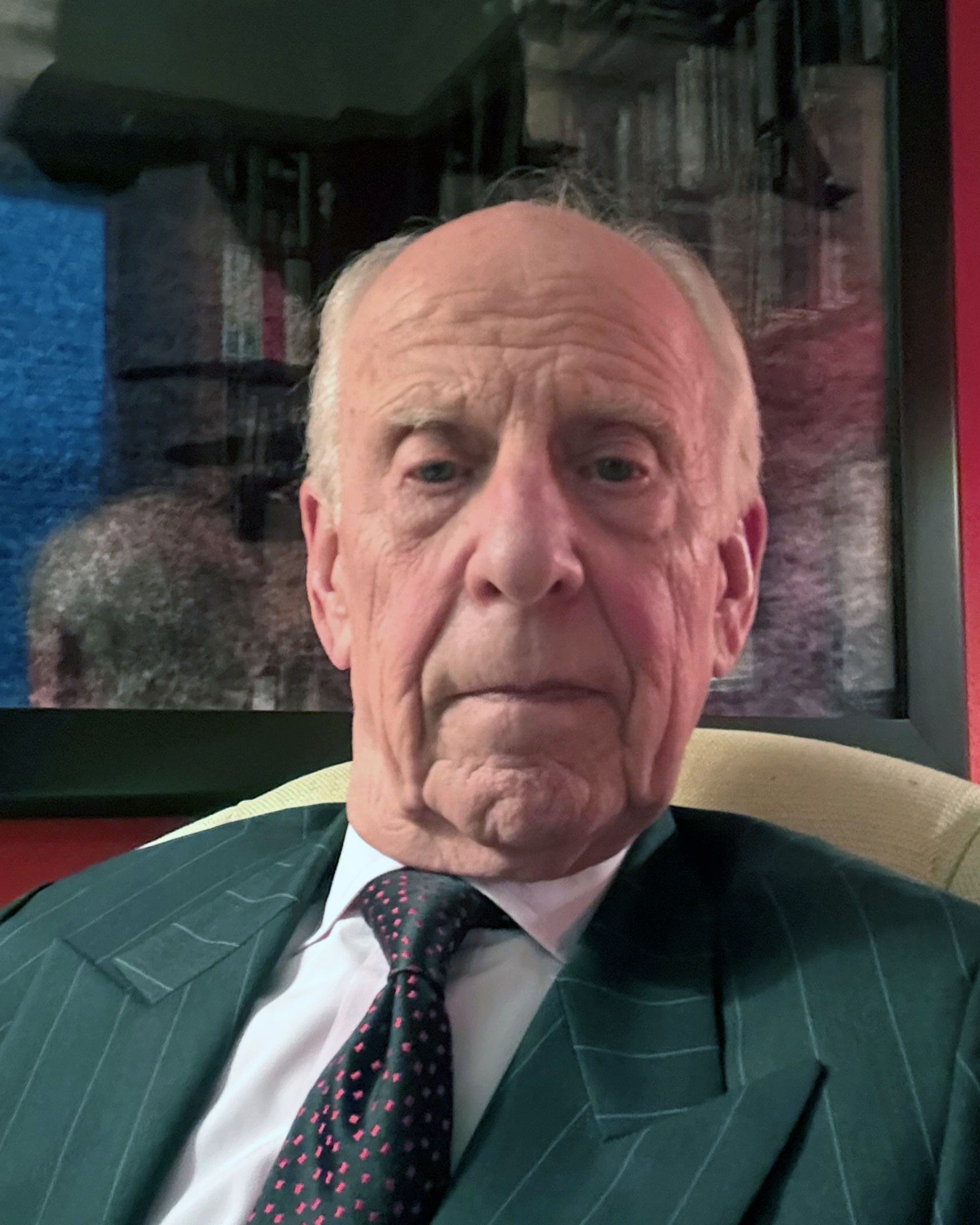
 R. Lawrence (Larry) McCaffrey had a mid-western upbringing in Nebraska, Iowa and Illinois. He was introduced to railroads at a very early age by a father who was fascinated by them and frequently took his son to watch the Denver Zephyr and Rock Island Rocket blast through town. McCaffrey found this stunningly boring.
After college and law school, McCaffrey pursued a legal career first in municipal bonds – a “new level of boredom” according to McCaffrey – and public housing. With the occurrence of the Penn Central Transportation Company and related bankruptcies of the early 1970s, the U.S. Department of Transportation (USDOT) was charged with restructuring the rail industry. These events marked McCaffrey’s entry into the railroad world.
In 1973 McCaffrey had the good luck to be appointed special assistant to the general counsel of USDOT. His primary role was being part of the interface with the U.S. Railway Association, which developed the Final System Plan for restructuring the bankrupt railroads. In 1975 President Gerald Ford appointed McCaffrey chief counsel of the Federal Railroad Administration. McCaffrey’s principal focus in that position was implementing some $1.6 billion of new loan and grant financing programs for railroads.
In March 1977, McCaffrey left USDOT to form a law firm in Washington D.C. His primary practice area was, no surprise, railroads. As a result of his USDOT experience, this practice was centered around seeking restructuring financing through USDOT programs rather than the much more common regulatory practice at the Interstate Commerce Commission (ICC), today’s Surface Transportation Board.
The breakthrough in McCaffrey’s firm came with an ICC decision for one of McCaffrey’s clients that created a policy of permitting acquisition of a rail line by a party that was not a railroad under expedited procedures and without labor protection mandated by other acquisitions. This new policy opened a huge door to sales of rail lines by Class 1 carriers to non-carriers, which thereby became new railroads. From there the short line industry blossomed with new railroads, most small but some quite large, resulting in among other things the transformation of the American Short Line Railroad Association (ASLRA) into ASLRRA.
McCaffrey’s law practice was very active throughout the 1980s as he assisted clients in some 40 states to establish new railroads. In 1983, he and his law partner, Peter Gilbertson, produced a book titled Starting A Short Line to provide a manual on the various aspects of creating, financing and managing a new railroad, which ASLRA supported. In 1985 McCaffrey and Gilbertson expanded on the scope of their work by creating Anacostia & Pacific, the initial thrust of which was to provide advisory services complimentary to the legal services provided by their law firm.
In 1991 The World Bank asked McCaffrey to consider working with private parties in Argentina to bring about a similar restructuring there as was occurring in the U.S. McCaffrey joined with Keith Hartwell of Chambers Conlon & Hartwell and Montana Rail Link to create a U.S. operator for the newly privatized Nuevo Central Argentino.
McCaffrey continued his privatization-related services in Chile in 1975. In 1998 he created UniRail LLC to give special focus to foreign privatizations. This became the focus of his career working on railroad privatizations in 16 different countries. His longest stint was in Bolivia where he served as board chair and investor in Ferrocarril Oriental for ten years.
A hallmark of McCaffrey’s railroad engagements was association with strong, capable and focused partners both domestic and foreign, who were essential to their success. He was a director and shareholder of ten separate railroads controlled by different ownership groups. While every country and state presented its special environment for its local economy, labor force, and financial condition, the common denominator of achieving operating efficiency and high-quality service learned from the U.S. railroad restructuring of the 1980s was always core to success.
Since 2018 McCaffrey has steadily reduced his participation in the industry, replacing it with engagement as a director and senior officer with non-profit entities such as Lehman College in the Bronx, a New York City park conservancy and an arboretum in the Catskills, for which he produced a book on native trees.
In hindsight, McCaffrey has recognized what was boring in his youth became a fascinating and rewarding career as an adult though the good luck of being in the right place at the right time with the right people.


